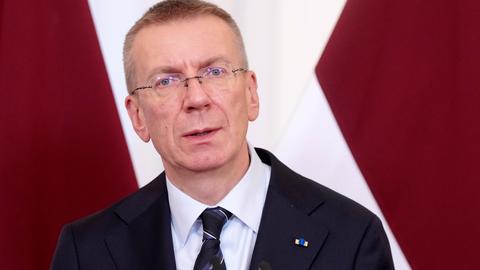
Latvia's Foreign Ministry proposes banning Russian and Belarusian grain transit via national sanctions
Latvia's Foreign Ministry has submitted to Prime Minister Andris Kulbergs a draft regulation to ban transit of Russian and Belarusian grain through national sanctions. The ministry says there is not enough EU member state support for a bloc-wide ban.

Latvia's Ministry of Foreign Affairs has prepared, together with other ministries, a draft Cabinet regulation that would ban the transit of grain of Russian and Belarusian origin across Latvian territory, and has submitted it to Prime Minister Andris Kulbergs. The ministry proposes setting the ban as national sanctions, because there is currently not enough support among European Union (EU) member states for a bloc-wide solution.
Why a national solution
On 13 October the ministry assessed three possible courses of action and presented them to the government. One of them envisaged achieving a ban at EU level through corresponding EU sanctions. Latvia has raised the issue in talks with EU institutions and member states, but support is still insufficient.
The ministry therefore suggests national sanctions based on Latvia's foreign policy and national security interests. According to the ministry, this mechanism allows specific restrictions to be set while also providing for monitoring of compliance and liability for violations. Competent authorities could supervise enforcement, identify violations and apply the liability set out in legislation.
Risks
The ministry notes that sanctions carry legal and economic risks: possible litigation over already concluded contracts, an impact on the transport and logistics sector and on state budget revenue, and the need to ensure compliance with EU law. It assesses these risks as manageable. Work at EU level will continue.
Earlier steps and transit volumes
On Tuesday, after a government meeting, Kulbergs said the Ministry of Agriculture is preparing a bill, and that assessments from the foreign and transport ministers are still needed. On Saturday, at a protest called "No to Blood Grain!", he promised to advance rules that would prevent new contracts on Russian grain transit. On 24 September the Saeima, Latvia's parliament, called on the government to draft rules to stop, and in future prevent, the import of Russian and Belarusian grain into Latvia, including in transit.
Data from the State Revenue Service show that in the first ten months of this year 1.115 million tonnes of grain were transported in transit from Russia through Latvia, compared with 357,645 tonnes a year earlier, a 3.1-fold increase. From Belarus, 185,756 tonnes were carried this year, against 60.8 tonnes last year.