Solution to Feynman's reverse sprinkler puzzle also applies to 'silly sprinklers'
Researchers at New York University have confirmed the momentum flux theory explaining how angular momentum of water drives rotation in reverse sprinklers, and extended it to silly sprinkler designs.
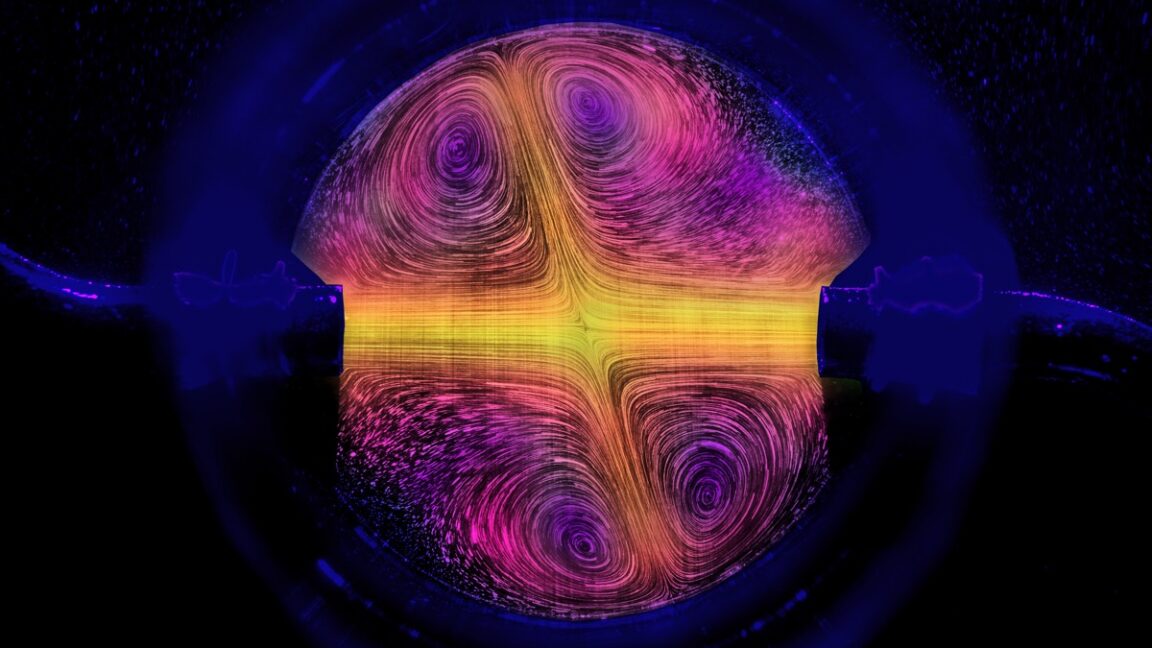
Researchers at New York University's Courant Institute have conducted experiments with various silly sprinkler designs to solve a long-standing problem in fluid dynamics, according to a new paper published in the Proceedings of the National Academy of Sciences.
The reverse sprinkler problem is associated with physicist Richard Feynman, who popularized it in the 1940s while a graduate student at Princeton University. The concept dates back to an 1883 thought experiment by Ernst Mach, who proposed that a reverse sprinkler would not rotate due to canceling forces. Feynman's own experiment showed a slight tremor but no sustained rotation.
In 2024, NYU applied mathematician Leif Ristroph and colleagues built a custom sprinkler with ultra-low-friction bearings and found that the reverse sprinkler rotates 50 times slower than a regular one, but operates on similar principles—behaving like an "inside-out rocket." However, that study only examined S-shaped arms.
In the new study, Ristroph et al. tested their own custom silly sprinklers in both forward (spraying) and reverse (sucking) modes. The observations strongly supported their momentum flux theory and were inconsistent with both Mach's and Feynman's hypotheses. The team also found that the arm shape controls jet flow and provided guidelines for designing structures to produce torque.
"Our findings provide a firmer understanding of how components respond to fluid flows—knowledge that can guide future engineering and technological advances for devices, such as turbines, that convert these flows into energy," said co-author Brennan Sprinkle of the Colorado School of Mines.
Ristroph's lab frequently tackles colorful real-world puzzles, including studies on bubble formation, stone forests, Tesla valves, and paper airplane aerodynamics.