Auburn Trials: Spray Drones Defoliated Cotton With Far Less Water Than a Ground Rig
In Auburn University field trials in Alabama, spray drones defoliated cotton about as well as a ground sprayer, even though their canopy coverage was lower and less even.
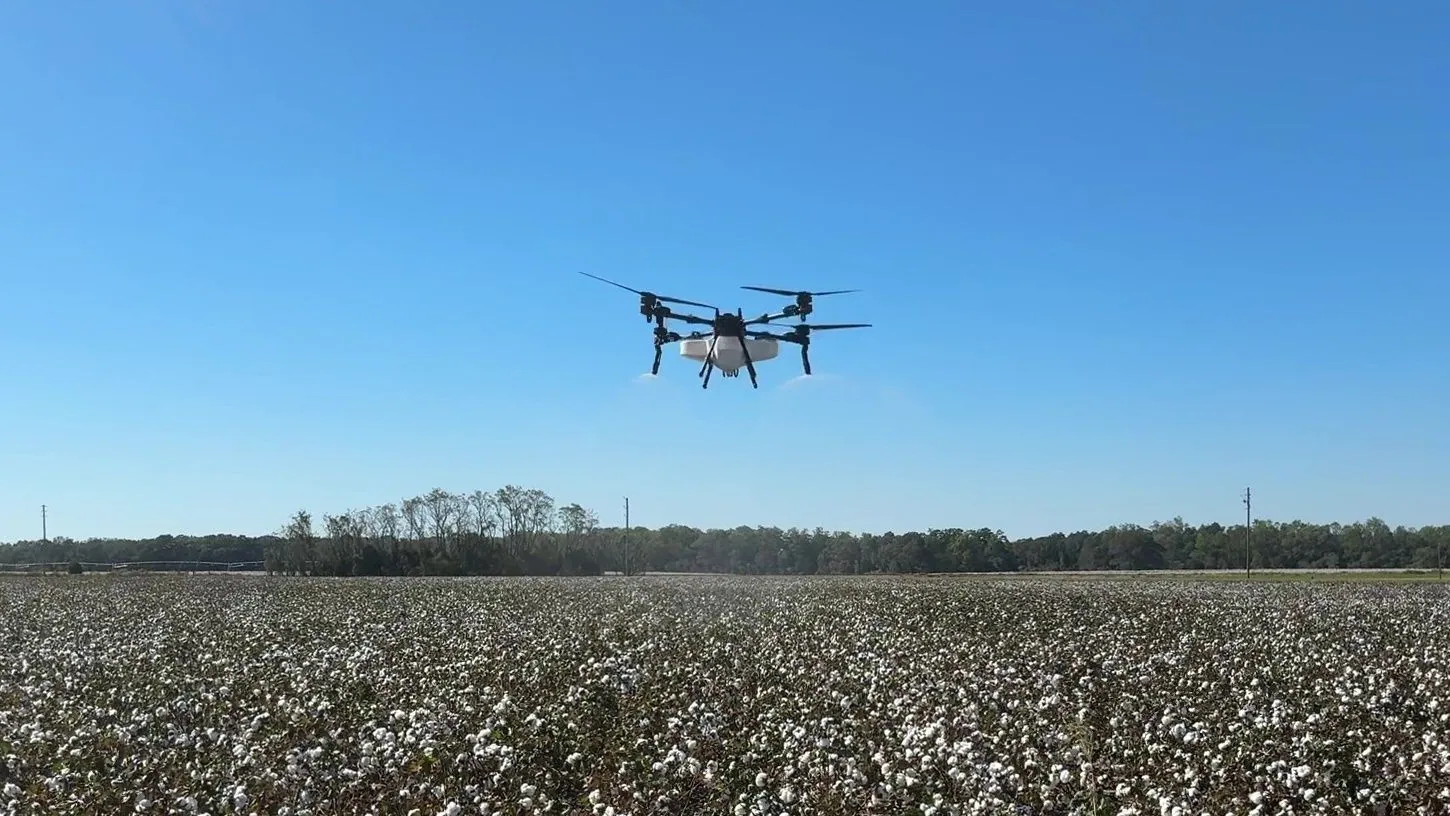
Spray drones defoliated cotton about as well as a ground sprayer in Auburn University field trials in Alabama, USA, even though they left lower and less even coverage on the plants. Defoliation is the removal of leaves before harvest. Simer Virk, a precision agriculture specialist at Auburn, reported the results on November 16 in a column for Farm Press. The findings matter because they suggest drones may do the job with much less spray liquid.
How the trials were run
The drones applied a three-way defoliant mix at 3 and 5 gallons per acre (about 28 and 47 liters per hectare). The ground rig applied the same mix at 10 gallons per acre (about 94 liters per hectare). Defoliation, lint yield and fiber quality were similar in every year of the study. According to an abstract filed for the CANVAS 2026 conference, the studies ran in Alabama in 2024 and 2025, with visual ratings 10 to 14 days after application. In one of the four site years, drone plots showed higher desiccation, which Virk says may be due to environmental conditions or other factors.
Coverage and evenness
Coverage was read from water-sensitive paper placed inside the canopy. The drone trailed the ground sprayer at the upper, middle and lower canopy levels. Virk attributes this to the ground rig's higher spray volume and a boom that rides closer to the plants. The drone was also less even: its spray forms a bell-shaped curve that stays variable even where neighboring passes overlap. At 5 gallons per acre the drone covered more of the plant than at 3, most of all in the upper canopy.
Limits and recommendations
Alabama Extension's 2020 cotton defoliation guide advises at least 15 gallons per acre by ground and 5 by air, and it does not mention drones. Virk's column gives no numerical coverage or yield figures and does not name the drone used. The abstract says data from both years were still being analyzed.
Virk writes that drones are another valid tool for applying cotton defoliants, but much remains to be learned. He advises applicators to calibrate the drone, determine an effective swath, follow the label on spray volume and droplet size, and fly only in weather that will not carry spray off target.