Azerbaijan, Georgia and Kazakhstan Expand Middle Corridor as Belgian Firms Eye Investment
Azerbaijan, Georgia and Kazakhstan have drawn up a joint plan to move 30 million tonnes of cargo a year along the Middle Corridor by 2029. Belgian companies are discussing a logistics hub in Kazakhstan and a digital pilot project.
Azerbaijan, Georgia and Kazakhstan are stepping up cooperation on the Middle Corridor, an emerging trade route linking China and Central Asia with European markets via the Caspian Sea and the South Caucasus to the Black Sea. The three countries have drawn up a joint plan to improve transport infrastructure, streamline logistics and speed up cross-border trade. According to the source, the war involving Iran has severely disrupted shipping through the Strait of Hormuz, raising the value of alternative routes.
Belgian companies show interest
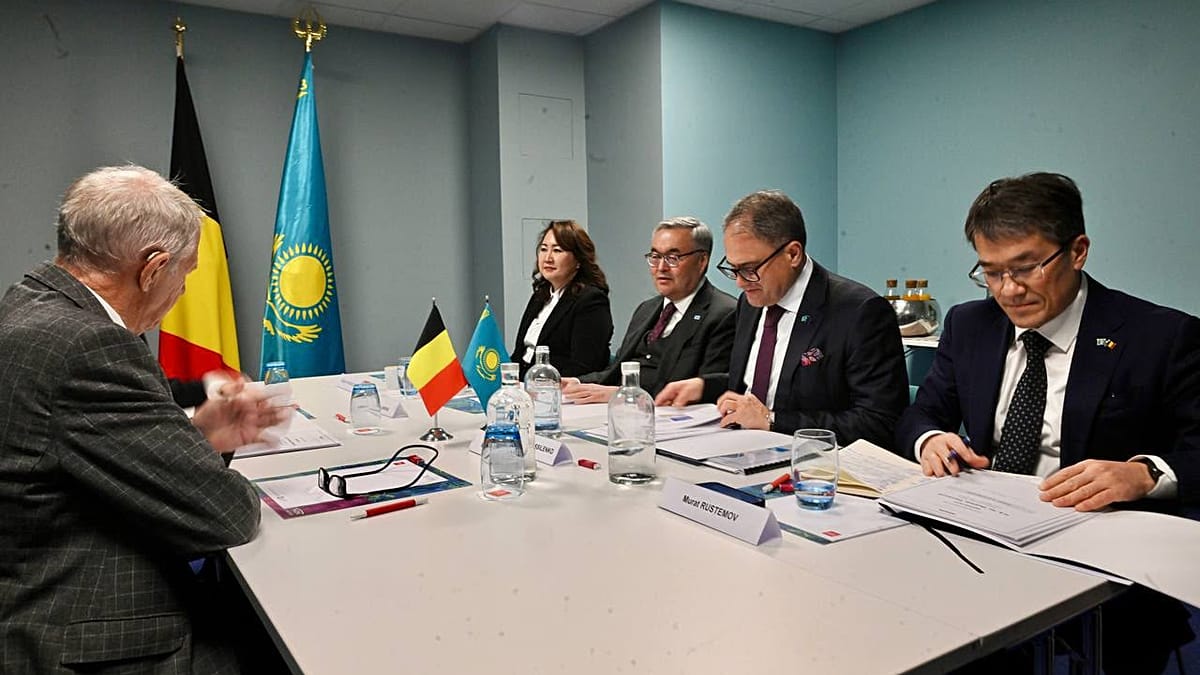
Kazakh Foreign Minister Mukhtar Tileuberdi met executives from the Belgian companies Sarens Group, Ahlers Logistics and BIM e-Solutions during a working visit to Brussels on 16 November. Kazakhstan's Foreign Ministry says the talks with Sarens Group representatives covered a proposed $50 million (€45.4 million) investment in the Zhetysu Region near the Chinese border. The planned transport and logistics hub would include a 2.1-kilometre bypass road, temporary storage facilities and infrastructure for heavy cargo. It would increase capacity at the Nur Zholy border crossing and ease freight congestion on the Kazakh-Chinese border.
Separate talks with Ahlers Logistics CEO Dave van den Bos and BIM e-Solutions head Michael Barrie covered a 90-day "Digital Middle Corridor" pilot, which would introduce digital freight tracking and simplify customs data exchange.
Target of 30 million tonnes by 2029
Georgian Deputy Prime Minister and Economy Minister Mariam Kvrivishvili confirmed to Imedi TV that the plan aims to carry 30 million tonnes of cargo through the corridor by 2029. Georgia intends to invest roughly $7 billion (€6.4 billion) in ports, railways, roads and aviation infrastructure by 2029. The joint measures include harmonising customs clearance, aligning tariff policies and expanding port and rail capacity.
Bako Kheladze, a research fellow at the Turan Research Centre, said limited freight capacity remains one of the corridor's biggest constraints. He noted that the World Bank estimated in 2023 that the route could triple its freight volume by 2030, yet it remains much smaller than the Northern Route through Russia.
In Brussels on Monday, EU officials and foreign ministers from several countries also attended the second Ministerial Meeting on Cross-Regional Security and Connectivity, where Tileuberdi stressed Kazakhstan's interest in cooperating with European partners.