Open-Air Museum marks Michaelmas with onion and fish festival
Estonia's Open-Air Museum held an onion and fish festival on Saturday to celebrate Mihklipäev, or Michaelmas Day. Visitors could taste traditional Seto holiday food and try making a lubok print at the Peipsi Old Believers' house.
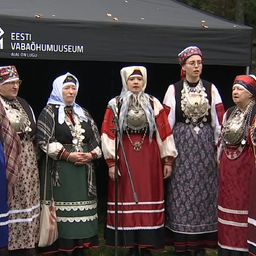
On Saturday, the Estonian Open-Air Museum hosted an onion and fish festival to mark Mihklipäev, known as Michaelmas Day, an important date in both the Slavic and Estonian folk calendars. The village square between the Seto farmstead and the Peipsi Old Believers' house was lively, filled with music and celebration.
Museum staff member Einike Soovali explained that Michaelmas is a pleasant autumn holiday — a time when the fresh harvest has already been gathered and stored in cellars, making it the perfect moment to celebrate. The Seto people traditionally mark the day with singing, dancing and festivities.
Traditional food
No festival is complete without food. In the kitchen of the Seto farmstead, a variety of dishes were prepared — a sauce of dried fish, onion and bacon simmered on the stove, a pie baked in the oven, and other dishes were being readied as well.
Museum staff member Kersti Aas said the traditional Michaelmas dish was stewed vegetables with meat, cooked in a pot. Vegetables from the freshly gathered harvest were used, with mutton from a sheep slaughtered for the occasion placed at the bottom, topped with fresh vegetables, and the whole pot sent into the oven. Visitors were also invited to try preparing food using old recipes themselves, such as making sauerkraut.
Making lubok prints
At the Peipsi Old Believers' house, preparations included baking pies with onion, and visitors had a unique chance to try making their own lubok prints.
Lubok craftsman Pavel Varunin explained that this is a form of Russian peasant folk art once used to decorate cottages, since it was cheap, simple and quite popular. He compared it to a Russian comic strip, featuring an image with a simple composition and drawing, always accompanied by an explanatory caption.
The process began with carving an image into a wooden board, which was then transferred onto paper by rolling on paint made from flax and soot and applying it to the printing board. To ensure an even print, wooden spoons were run along the lines of the drawing to keep the image sharp. Once the lubok was finished, it only remained to be colored in and used to decorate a cottage.
/nginx/o/2026/10/02/17950450t1h70cc.png)

