Claas forage harvesters to check knife sharpness on their own
Claas, a manufacturer of agricultural machinery, is introducing Cemos Auto Knife Condition, a system that assesses the sharpness of forage harvester knives and tells the operator when to sharpen them. It will be available on the Jaguar 1000 series from model year 2027.
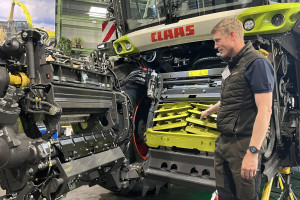
Agricultural machinery maker Claas has announced that from model year 2027 its Jaguar 1000 forage harvesters, the machines used to chop maize for silage, will gain several new features. The most notable is knife sharpness monitoring, intended to help keep the cut consistent when maize is harvested for silage.
Why knife sharpness matters
In maize harvesting, what counts is not only the machine's output but also how well the plants are chopped. Dull blades can tear the material and make it harder to keep the chopped length uniform. The structure of the chop affects how well the material can later be compacted in the silage clamp. Knife wear depends on harvesting conditions, and until now operators have usually decided when to sharpen based on experience or set time intervals.
How the system works
Cemos Auto Knife Condition uses two reluctance sensors that monitor the geometry of the cutting edges across the full width of the knives with a static magnetic field. The sensors sit above the knife drum, outside the flow of material. In the Cebis terminal, the operator sets the desired sharpness level and a sharpening strategy. If the system detects excessive dulling, it shows a message, but it does not start sharpening by itself.
The manufacturer says this can extend knife life, maintain cutting quality and reduce fuel use, but Claas gives no specific savings figures. Contractors will be able to analyse knife wear field by field using data stored in Claas Connect. The system was shown at Agritechnica 2025 for the Jaguar 900 series.
Other changes
The Jaguar 1000 will also get live yield mapping through the GPS Pilot Cemis 1200 terminal, showing fresh and dry matter yield, moisture and dry matter percentage. The Nutrimeter sensor, which uses near-infrared (NIR) technology, will be able to analyse nutrient content in slurry and digestate as well. Active damping of spout vibration and two new headers are also added: the 16-row Orbis 12000 (12 m) and the Direct Disc 8400 (8.41 m). The new features are planned for Jaguar 1000 machines rated at 850 to 1,110 horsepower.