South Korea and Central Asian states agree 30-year cooperation framework
South Korea and five Central Asian nations held their first leaders' summit in Seoul, adopting a long-term cooperation plan on critical minerals, energy and supply chains, alongside a new regular format for leaders and industry ministers.
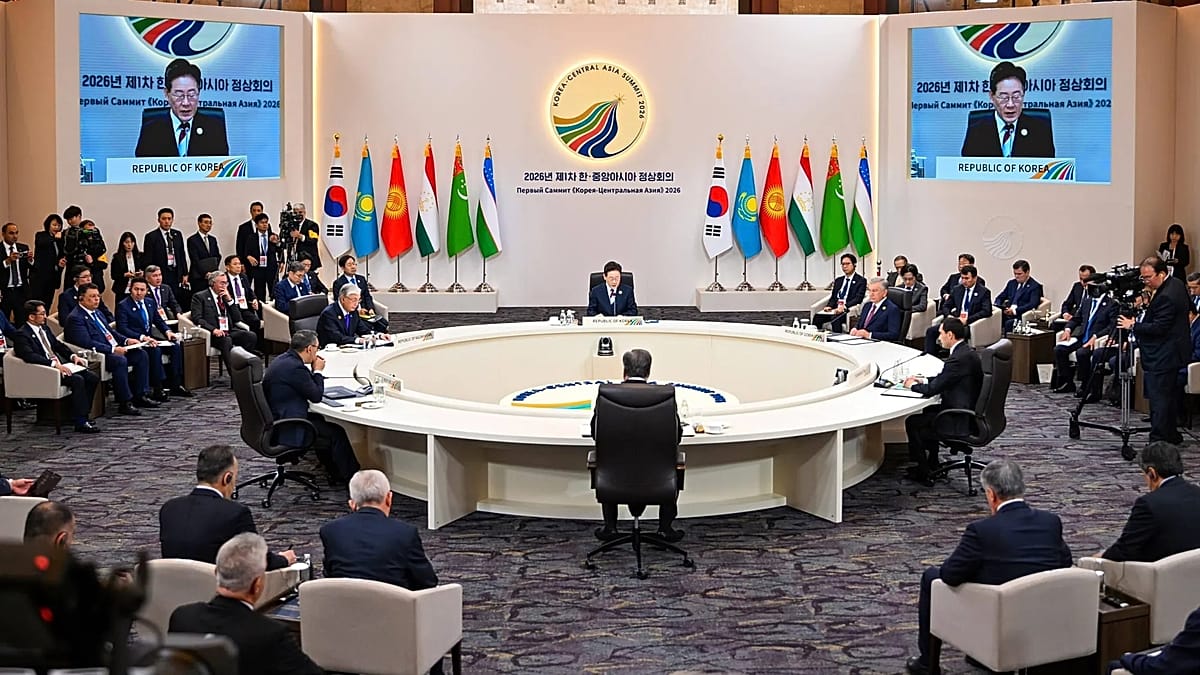
South Korea and the five Central Asian republics — Kazakhstan, Kyrgyzstan, Tajikistan, Turkmenistan and Uzbekistan — held their first heads-of-state summit in Seoul on Wednesday. Leaders adopted a declaration setting out a 30-year cooperation framework covering critical minerals, energy, supply chains and emerging technologies, invoking the region's shared Silk Road history.
The agreement establishes a leaders' summit to be held every two years, along with a new mechanism bringing together industry ministers from all six countries. South Korean President Lee Jae-myung said the connective spirit of the historic Silk Road, linking people, technologies and cultures across East and West, is needed more than ever today.
Shared interests
South Korea is seeking more diverse sources of critical materials for industries such as semiconductors, batteries and electric vehicles, while Central Asian governments want greater technology transfer, investment and a bigger role in manufacturing products from their own resources. Uzbek President Shavkat Mirziyoyev said the region is no longer merely a raw-materials supplier but is actively integrating into global value chains. He proposed a Regional Investment Alliance for Critical Minerals and set a target of $20 billion in trade between South Korea and Central Asia by 2030. Kazakh President Kassym-Jomart Tokayev noted his country holds all ten minerals South Korea classifies as strategic.
Transport link to Europe
Transport connectivity was a major theme, with Tokayev proposing an end-to-end logistics chain from Korea through Central Asia to Europe via the Middle Corridor, which crosses the Caspian Sea to Azerbaijan and Georgia. The route has gained attention as an alternative to paths through Russia, with freight volumes reportedly increasing fivefold over six years.
The same day saw the first Korea–Central Asia Business Summit, gathering more than 500 participants and producing 19 memorandums of understanding covering critical minerals, infrastructure and digital technology. The next leaders' meeting is scheduled for Kazakhstan in 2028.