James Webb telescope finds ice older than the star it orbits
Using the James Webb Space Telescope, researchers found that ice in the debris disk around the star Beta Pictoris most likely formed in interstellar space before the system's planets began to form. The findings were published in the journal Science.
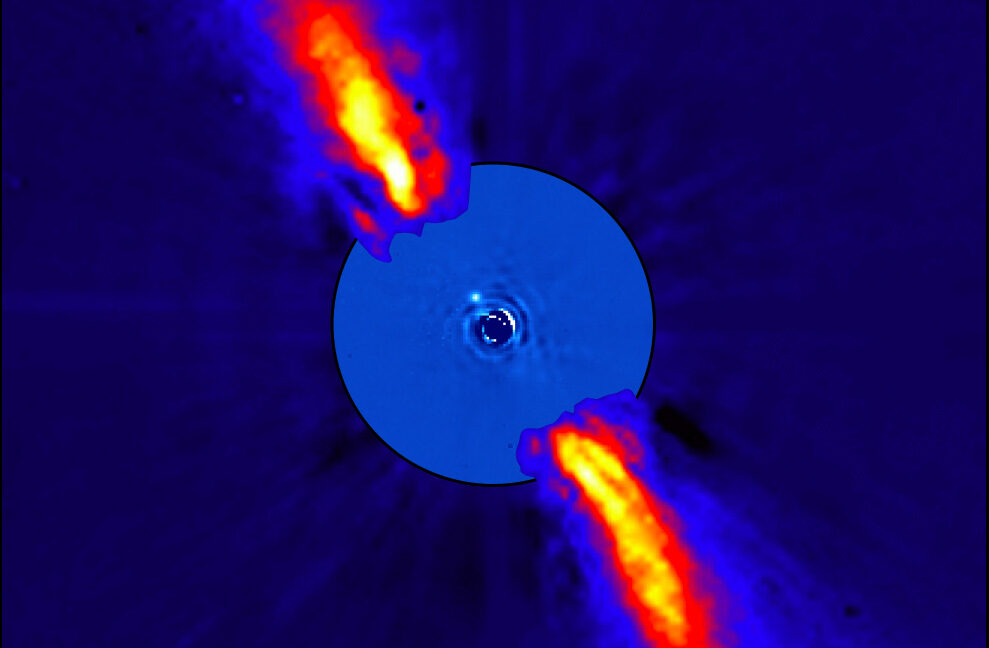
Astronomers using the James Webb Space Telescope have found water ice around Beta Pictoris, a young star system about 64 light-years from Earth, that most likely predates the star itself. The study was published in the journal Science. It matters because it suggests that primordial interstellar ice may be a common ingredient of planetary systems, including those that could form water-rich worlds.
Amorphous ice
The researchers examined the structure of the ice through its spectrum. Crystalline ice produces a sharp peak just above 3 micrometers, but that peak was missing at Beta Pictoris. The ice is almost entirely amorphous, a disordered, glass-like solid that forms when water freezes very quickly at very low temperatures. The team estimates that less than 7 percent of the ice in the system is crystalline, which is somewhat surprising, since models predicted that ice in debris disks should be mostly crystalline.
For ice to remain amorphous, it must stay colder than about 100 kelvin, or minus 173 degrees Celsius. Otherwise, something has to keep breaking up the crystal structure, such as high-energy ultraviolet light, cosmic rays or particles streaming from the star. The researchers concluded that the ice most likely formed in the interstellar medium, long before the planets of Beta Pictoris began to take shape.
Constant collisions
The remaining question was how the icy grains became spread so evenly across the disk. The team argues that this requires frequent collisions among planetesimals. Each collision would release fresh icy dust, including ice that had been buried and protected deep inside the colliding bodies, replenishing what the star's light destroys. Earlier infrared images showed a curved, lopsided streak of dust in the disk's southwestern arm, thought to be debris from a violent collision. The new findings support the idea that the disk's carbon monoxide gas comes from colliding icy bodies.
The team could not determine exactly how much crystalline ice is present or rule out other molecules hiding in the mixture.

