European-Japanese BepiColombo spacecraft reaches Mercury ahead of orbit insertion
The joint European-Japanese BepiColombo mission has arrived at Mercury after more than eight years in flight. Controllers will fire its thrusters on Saturday to place it in orbit.
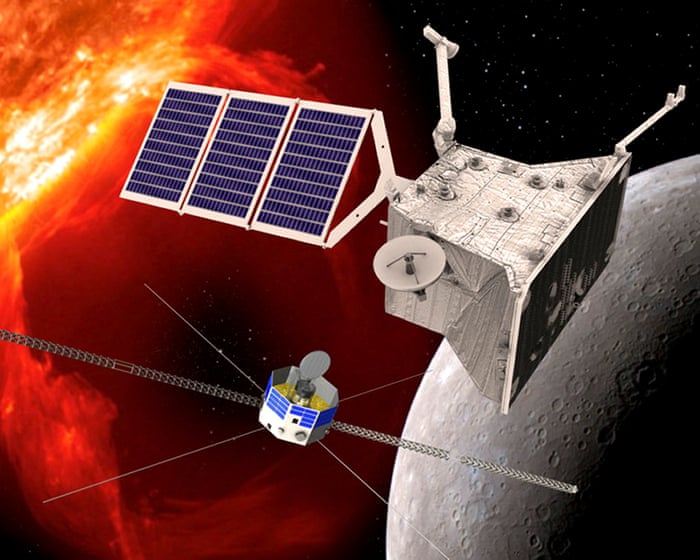
The joint European-Japanese BepiColombo space mission has reached Mercury, the closest planet to the sun and the smallest in the solar system, after a journey of more than eight years and 6bn miles. On Saturday, flight controllers will fire the spacecraft's thrusters to put it into orbit around the planet, making it only the second mission in history to circle Mercury. The mission cost €1.6bn.
Researchers hope it will explain how Mercury formed so close to the sun, why it has a magnetic field, and what makes up the ice in its permanently shadowed craters.
A difficult destination
Reaching Mercury is hard. Because the planet lies near the centre of the solar system, spacecraft speed up under the sun's gravity and must spend much of their journey braking to avoid flying straight past. "It's a very complex and challenging mission," said Prof Emma Bunce of the University of Leicester, who has worked on the project for 20 years and is principal investigator for the Mercury Imaging X-ray Spectrometer (MIXS), an instrument that will analyse the geochemical composition of the surface.
What happens next
Scientists will not be able to begin observations immediately. In early December the spacecraft will split into two orbiters, one European and one Japanese, which will move into different polar orbits. Science operations are due to start in April next year.
The European probe, the Mercury Planetary Orbiter (MPO), will map the surface and its composition in high resolution and study the planet's interior to learn more about its unusually large core. The Japanese orbiter will measure the magnetic field and the sodium exosphere, an extremely thin layer of gas and atoms around the planet. Mercury is only 50% larger than the moon but has four times its mass, and one question is why it is so dense.
Prof Geraint Jones, lead project scientist for BepiColombo at the European Space Agency, said anticipation of the results had kept the team enthused throughout the long journey.
Mercury rotates once every 58 Earth days, so any spot can have three months of daylight followed by three months of night. It sits at 36m miles from the sun, a little over a third of Earth's distance. Daytime ground temperatures reach 450C and night-time temperatures fall to -180C.
The two spacecraft are expected to orbit for about three years, after which they will run out of fuel, lose altitude and crash into the surface.