European countries differ on how long households should prepare for a crisis — 72 hours to two weeks
European countries lack a unified standard for how long households should be able to cope on their own during a crisis, with most recommending at least 72 hours while some scenarios call for up to two weeks of self-sufficiency. At EU level, preparedness is increasingly framed as a shared responsibility between states and citizens.
More frequent drone incidents, airspace violations, severe storms and power outages are reminding Europeans that a crisis doesn't always start with war — a power cut, closed shops or disrupted communications can be enough. This has raised a practical question: how long should a household be able to manage without outside help?
72 hours as a benchmark
In March 2025, the European Commission presented the EU Preparedness Union Strategy, recommending that citizens be able to cover basic needs for at least 72 hours. Though not legally binding, the three-day principle has become a widely used benchmark, adopted by Lithuania, Poland, Finland, Latvia, Czechia and Romania. Latvia additionally recommends preparing for three to seven days. Slovakia has no single timeframe: it suggests supplies for two to three days in case of evacuation, but at least 14 days for a prolonged power outage.
Supplies and equipment
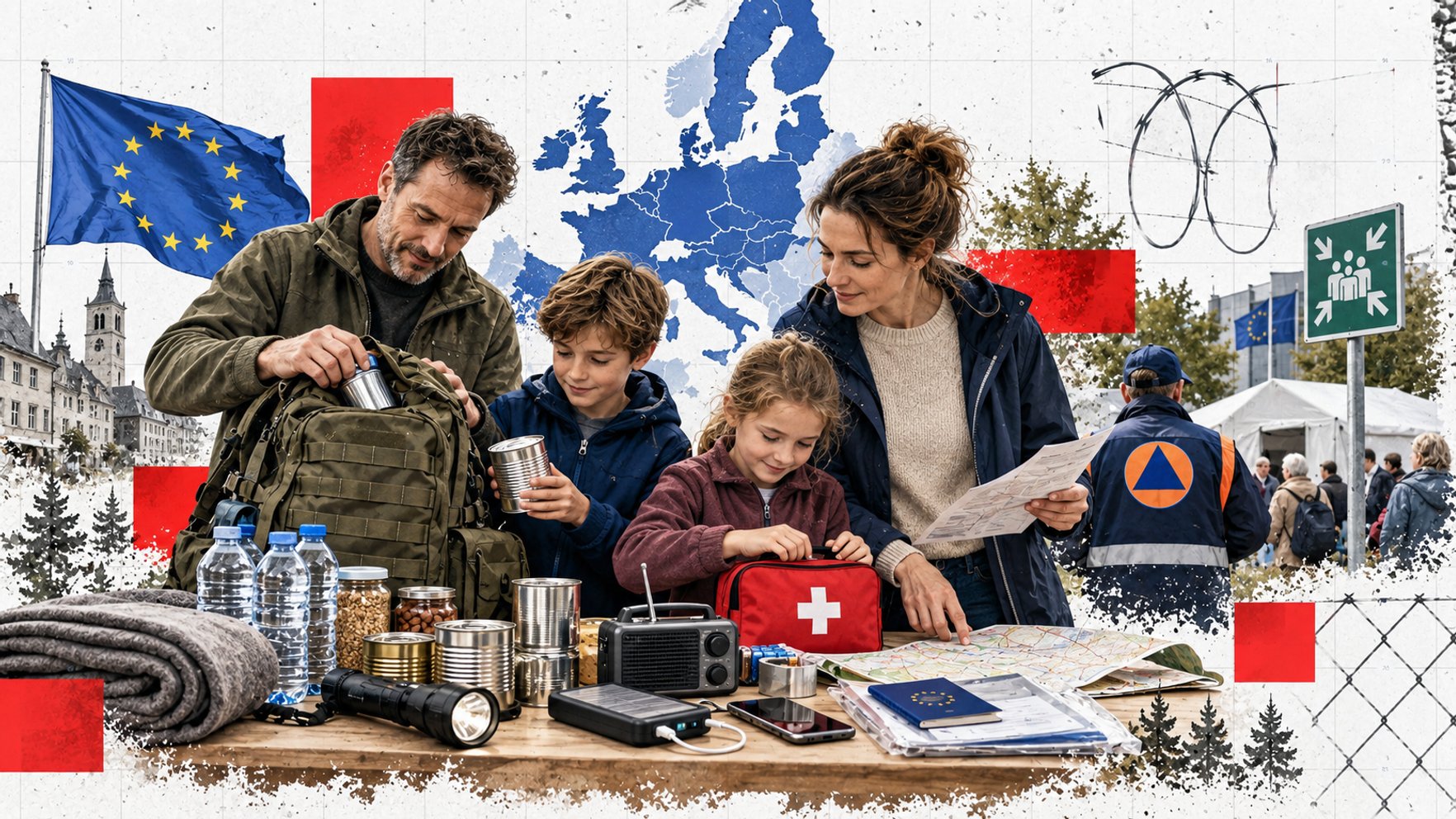
Most countries recommend keeping water, long-lasting food, medication, first aid supplies, a battery radio, a flashlight, cash, a power bank, hygiene items and copies of documents at home. Finland goes further, urging people to consider how to keep a home warm without electricity and how to access information without internet access. No country requires a generator, though Romania recommends one for rural households and people dependent on medical devices.
Limits of warning systems
Countries increasingly rely on mobile phone alerts, sirens and radio. But having a system doesn't guarantee results — in July 2026, sirens sounded in Poland's Lublin region after an airspace violation, but residents didn't receive warning texts, with authorities citing insufficient time. In Finland in May 2026, a mistaken drone alert showed how hard it can be to clearly communicate when a threat has passed.
No unified approach everywhere
Bulgaria and Hungary base their recommendations on specific risks, such as floods or earthquakes, rather than a general timeframe. The EU strategy also draws on the 2024 Niinistö report on civil and military preparedness, and in July 2025 the Commission adopted an EU stockpiling strategy to improve access to food, water, fuel and medicine during major crises.