Hackers publish Ksenia Sobchak's private messages, revealing alleged agreements with Russian officials
Hacker group Black Mirror and the anonymous project VChK-OGPU have released private messages and voice recordings attributed to journalist and media executive Ksenia Sobchak. The materials show correspondence with Ukrainian presidential office head Andriy Yermak and Russian officials, suggesting alleged deals between Sobchak's media empire and the Kremlin.
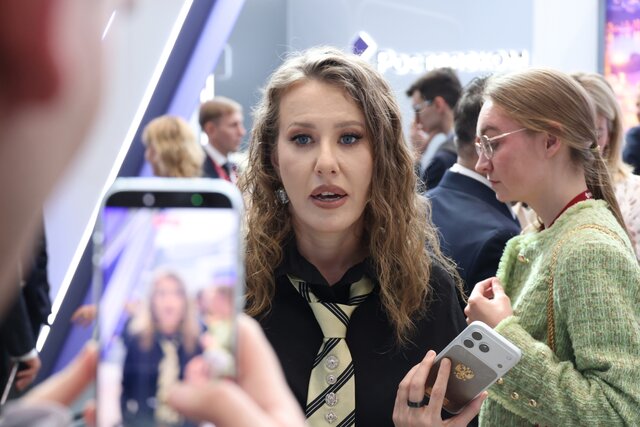
On July 8, journalist Ksenia Sobchak announced that hackers had breached her email and briefly accessed her Telegram channels. Screenshots of her private correspondence soon appeared in her channels, which she dismissed as fakes and deleted. The next day, the hacker group Black Mirror and the anonymous project VChK-OGPU published more screenshots and voice messages. Meduza cannot confirm or deny the authenticity, but believes the leaks illustrate power and censorship mechanics in today's Russia.
Black Mirror has been active since at least 2019, selling personal data of individuals connected to the Russian state. The group gained notoriety for publishing Alexei Navalny's autopsy report. VChK-OGPU, run by former Rosbalt journalists Alexander Shvarev and Alisher Abdullayev, specializes in compromising material.
The leaked correspondence includes exchanges with Andriy Yermak, then President Zelensky's chief of staff, in March 2022, where Sobchak discussed relocating her newsroom after Russia's invasion of Ukraine. In July 2024, she messaged Sergei Novikov, the Kremlin's chief censor, seeking approval for a music festival; Novikov refused, citing past reproaches.
Correspondence with Vladimir Tabak, head of the propaganda outfit ANO Dialog, reveals tension over an interview with pro-government blogger Ilya Remeslo, who later ended up in a psychiatric hospital. Tabak threatened not to forgive her. In exchanges with Alexei Nemeryuk, Moscow's trade chief, Sobchak complained about censorship of the gasoline crisis coverage, referencing written agreements she was fulfilling but not getting promised exclusives.
After the largest Ukrainian drone attack on Moscow on June 18, Sobchak received Kremlin complaints about her channel's coverage. A voice recording shows her citing violations of "agreements" and demanding clarification. Hackers also published an exchange with her editor-in-chief Sergei Titov, demanding a report on the coverage.
Sobchak's media empire includes the YouTube channel Ostorozhno Sobchak (4.15 million subscribers) and several Telegram channels. The leaks suggest close ties between her outlets and Russian authorities regarding media censorship.
/nginx/o/2026/01/09/17380420t1hb1fb.jpg)
/nginx/o/2026/09/28/17944290t1h9b26.jpg)