Pressure mounts on Europe's biggest port to go greener
The Port of Rotterdam, Europe's largest, faces growing pressure to reduce its reliance on fossil fuels, fueled by a lawsuit and environmental criticism. The port plans to cut its own emissions by 90% by 2030, but faces significant challenges.
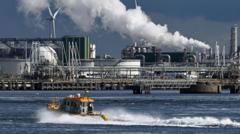
The Port of Rotterdam, located at the delta of the Rhine and Meuse rivers in the Netherlands, is the largest freight port in Europe. It hosts five refineries, including Shell's largest in Europe, and is a major energy and chemicals hub. According to research by CE Delft, the fossil fuels flowing through the port are linked to around 600 megatonnes of CO2 per year – many times more than the emissions of Schiphol Airport.
Environmental group Advocates for the Future has filed a lawsuit arguing that the Port of Rotterdam Authority is not doing enough to phase out fossil energy and wants a concrete plan to wind down coal, oil and gas flows. The port's own industrial cluster currently emits about 29 million tonnes of CO2 annually, roughly half of the Netherlands' domestic emissions, says Mark van Dijk, head of external relations at the Port Authority.
The Port Authority has a plan to cut its own direct and purchased energy emissions by 90% between 2019 and 2030. This includes developing a hydrogen hub, investing in onshore power for ships, and supporting bunkering of alternatives like LNG, biofuels, and methanol. There is also a carbon capture and storage project called Porthos.
However, activists argue the port should use its influence to speed up the transition. The port's leverage is limited because many major emitters are owned by US or Chinese companies and could move elsewhere if rules become too strict. Additionally, the lack of power cables hampers electrification. Emeritus professor Harry Geerlings believes the port authority wants change but its main income is still tied to fossil fuels. He calls for a global level playing field.
Advocates for the Future demand a detailed phase-out plan for fossil activities, not just a promise of climate neutrality by 2050.
/nginx/o/2026/01/09/17380420t1hb1fb.jpg)

/nginx/o/2026/09/28/17944290t1h9b26.jpg)