Estonian experts: Xi Jinping came out ahead at Shenzhen summit
A trilateral meeting of the leaders of the US, Russia and China on the sidelines of the APEC summit in Shenzhen produced no major decisions. Estonian analysts say Chinese President Xi Jinping benefited most, while Russia's Vladimir Putin was visibly sidelined.
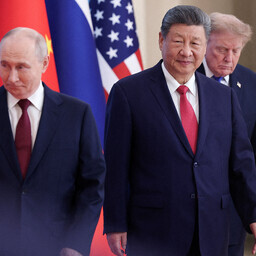
US President Donald Trump, Russian President Vladimir Putin and Chinese President Xi Jinping met on Thursday in Shenzhen, China, on the sidelines of the Asia-Pacific Economic Cooperation (APEC) summit. The talks yielded no major decisions, and Estonian foreign policy analysts conclude that Xi gained the most, while Russia's diminished standing became more visible.
The leaders discussed United Nations reform and nuclear arms limits but reached no concrete agreements. A "peace declaration" was adopted, yet the wars in Ukraine and Iran were left out. According to The Guardian, the three pledged to maintain strategic stability, support UN reform, increase refined oil supplies and guard against nuclear war, without laying out a framework for denuclearization.
Assessments from Estonian politicians and experts
Member of the European Parliament Riho Terras (Isamaa party) told Estonian public broadcaster ERR's "Aktuaalne kaamera" that the Chinese and American leaders met and Putin simply tagged along, as he played no significant role in that context. In his view, Beijing signals with its every move that Moscow is no longer a major player on the world stage.
Estonian MP Raimond Kaljulaid (Social Democrats, SDE) argued that Putin should never have been given the chance to appear as a legitimate statesman, and criticized Trump's embrace and joint photo op with the Russian leader.
Security expert and presidential adviser Rainer Saks said China has stepped onto the level once occupied by the Soviet Union and the US, which he sees as visual confirmation of a broader shift in the international system. He noted that Beijing showed no wish to discuss Russia's war in Ukraine, though it inevitably arose in bilateral exchanges. POLITICO reported that Trump afterwards phoned European allies and cast sharp doubt on continued military aid for Kyiv.
Putin's invitation to European leaders
Putin invited European leaders to Moscow for bilateral talks ahead of broader peace negotiations. Saks called this a classic tactical move to split a united European front, though he said it should not be dismissed outright. Terras warned that European leaders must not travel to Moscow, saying any talks should be held on neutral ground and only once Russia is genuinely ready for peace.
European leaders reacted sharply to the warm optics between Trump and Putin.