Estonian scientists uncover cause of dangerous water oscillations in Bulgaria's Varna canal
TalTech researchers have identified the cause of strong, hazardous currents in the narrow canal linking Lake Varna to the Black Sea, findings that could improve shipping safety and port operations.
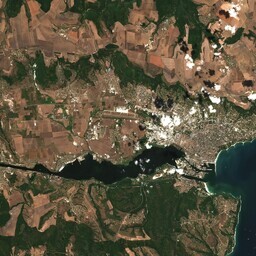
Scientists from Tallinn University of Technology (TalTech), working with the Port of Varna in Bulgaria, have explained a long-observed phenomenon in the 2.4-kilometer, 300-meter-wide canal connecting Lake Varna to the Black Sea. Pilots navigating the canal have for years reported unusually strong and unpredictable currents.
Academician and professor Maarja Kruusmaa led the research together with researcher Laura Piho, who deployed three Hydromast measuring stations — developed at TalTech's Center for Biorobotics — to record current speed, direction and water levels at one-minute intervals. Jüri Elken, professor emeritus of oceanography, helped interpret the results.
Dangerous oscillations
The measurements showed that, beyond normal moderate water movement, the canal can experience strong oscillations lasting several dozen minutes, with periods of 37 and 19 minutes being especially pronounced. According to the team, these oscillations stem from resonance within the canal-lake system, which can be dramatically amplified under certain weather conditions.
Two particularly strong events were recorded during the study. The first was a sudden onset of oscillations lasting a few cycles, triggered by a meteorological tsunami — a phenomenon that can occur when a weather front crosses shallow coastal waters at a matching resonance speed. The second occurred more than five hours after a storm, when offshore winds reached 20 meters per second; over just 10 minutes, current speeds shifted by up to 0.8 meters per second and water levels changed by as much as 0.8 meters. The researchers said fluctuations of this magnitude make passage through the canal highly hazardous for ships and disrupt port operations.
The team noted their findings demonstrate how combining high-frequency measurements with mathematical modeling can detect and predict dangerous water oscillations that might otherwise go unnoticed — knowledge that could also help other regions facing similar conditions improve navigation safety and early-warning systems. The study, authored by Elken, Piho and Kruusmaa, was published in the journal Ocean Science.