India's first privately-developed rocket reaches orbit on debut launch
Skyroot Aerospace's Vikram-1 rocket successfully reached orbit on its first attempt, marking India's first fully commercial satellite launcher and a major milestone for the country's private space industry.
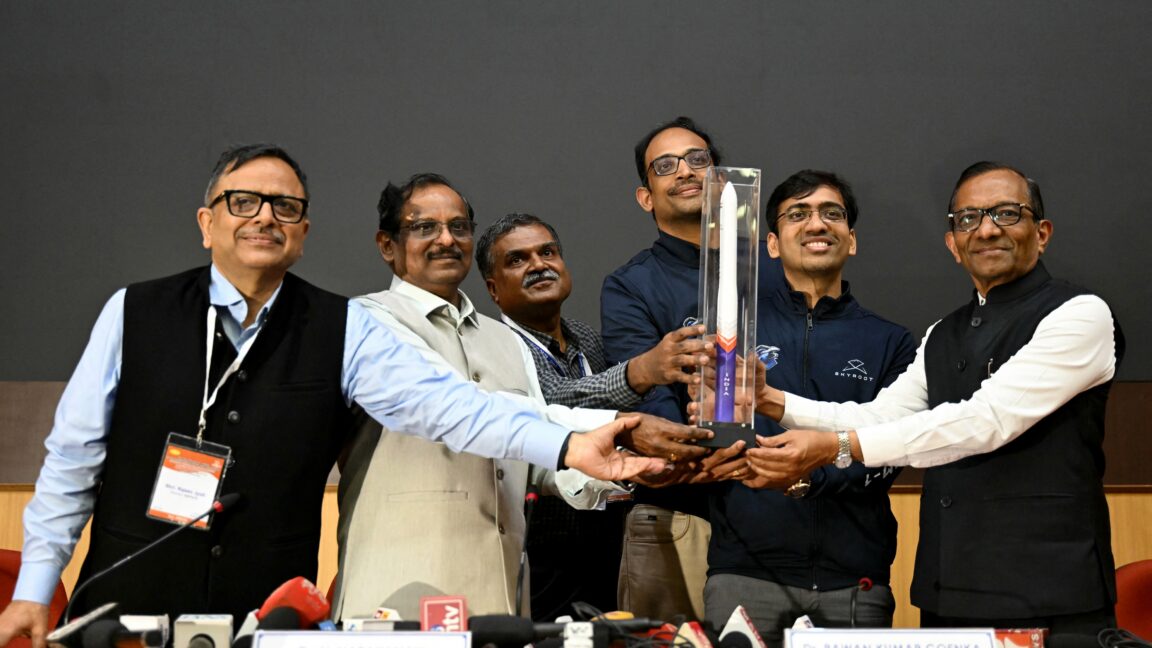
India's space sector achieved a historic milestone on Saturday as Skyroot Aerospace's Vikram-1 rocket successfully reached orbit on its very first launch. The liftoff occurred from the Satish Dhawan Space Center on Sriharikota Island in the Bay of Bengal, after a brief delay to resolve a last-minute technical issue. The rocket climbed to an orbit approximately 450 kilometers high, carrying a payload of small satellites.
The Vikram-1 is a small launch vehicle, standing 22 meters tall and capable of lifting up to 350 kilograms to low-Earth orbit, making it slightly larger than Rocket Lab's Electron. The flight proceeded smoothly, with three solid-fueled stages firing in succession, followed by a liquid-fueled fourth stage that accelerated the payload to orbital velocity. While the separation of the third stage was not perfectly clean—the spent stage remained close to the fourth stage—the upper stage performed flawlessly, deploying two CubeSats and hosting other payloads. US military tracking confirmed the successful orbital insertion.
Skyroot CEO Pawan Kumar Chandana expressed astonishment at reaching orbit on the first attempt, noting that most private companies fail on their debut. The company had set modest goals—simply to lift off and clear the tower—but exceeded them by achieving orbit and deploying all satellites. The Indian space agency ISRO supported the venture by providing access to test facilities and a launch pad.
The rocket, named after physicist Vikram Sarabhai, is made of lightweight carbon composite. Skyroot plans to develop larger versions, including the Vikram-1U with strap-on boosters and the Vikram-2 with a cryogenic upper stage, capable of lifting up to 900 kilograms. The company, founded in 2018 by former ISRO engineers, has raised about $160 million and employs over 1,000 people, with an average age of 28.
India's Prime Minister Narendra Modi, who aims to increase the country's annual launches from five to 50 by the end of the decade, congratulated the Skyroot team. The successful launch positions India as a significant player in the global small satellite launch market, alongside the US and China. A second Vikram-1 launch is expected before the end of the year.