Iran's president denies repeated resignation threats amid Hormuz deal dispute
Masoud Pezeshkian rejects reports he repeatedly offered to resign, as hardliners and officials clash over a proposed US agreement on the Strait of Hormuz.
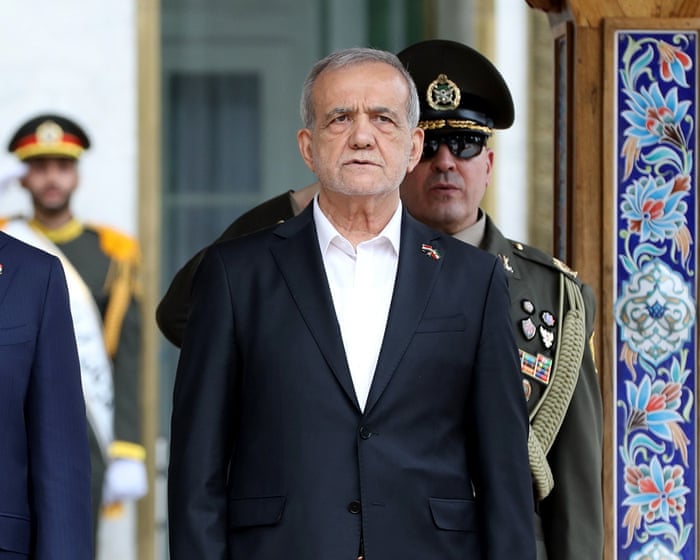
Masoud Pezeshkian, Iran's president, has publicly rejected reports that he repeatedly offered to resign as he faces opposition from hardline factions against a possible agreement with the United States over the Strait of Hormuz. The US and Europe hope a deal is imminent to reopen the strait and are pressuring Oman to accept a temporary agreement, which Omani officials fear would leave Iran with near-permanent dominance of the vital oil shipping route. Under the plan, ships would enter the strait close to Iran and leave through Iranian and Omani waters.
In a television interview marking his second year in office, Pezeshkian denied having offered to resign verbally or in writing. He accused unnamed figures of trying to create a rift inside Iran and said: "If I want to resign, I will officially announce that I have resigned. I will not resign, I will stand."
The claims, which have been front-page news in Iran, were made by Mohammad Bagher Kharazi, linked by marriage to the new supreme leader, Mojtaba Khamenei. Kharazi alleged that Pezeshkian was frustrated by being excluded from decision-making, made worse by the supreme leader's reluctance to reveal his whereabouts for fear of foreign intelligence agencies. Khamenei was seriously injured in the Israeli bombing on the first day of the war that killed his father, and has not been seen in public since. On Tuesday, Khamenei's office described the resignation allegation as "fundamentally false and untrue."
Pezeshkian insisted in the interview that he was in complete harmony with the military and challenged claims that 30,000 people had been killed in January protests, saying those who made the allegation never took up the offer to provide proof.
The row has highlighted deep strategic divisions in Tehran over talks with Washington. Mehdi Tabatabaei, a senior member of the president's office, dismissed the reports as "complete nonsense and lies," condemning a "sinister coalition of lying, deceitful and reckless extremism" whose members could not accept democratic outcomes. Reformist journalist Ahmad Zeidabadi said the claims were inflammatory and only increased tensions.
Pezeshkian said on Sunday that the memorandum of understanding negotiated with the US in June, and reviled by some hardliners, would become a cornerstone of Iranian foreign policy, arguing that Iran must strive to keep the enemy committed to what it has signed. On Monday, the conservative-dominated Assembly of Experts issued a statement calling hopes for an agreement with the US "futile," labelling "whispers of capitulation in the name of defending peace" an "unforgivable betrayal" and saying that trusting this arrogant government was nothing more than a mirage.
Khamenei himself had said in April he was opposed to talks with the US in principle, but in deference to Pezeshkian had allowed them to go ahead.
