Japan to launch world-first mission to bring back samples from Martian moon Phobos
Japan's space agency Jaxa plans to launch a spacecraft on Tuesday to return samples from Mars's moon Phobos to Earth for the first time. The roughly five-year mission could help explain where the Martian moons came from.
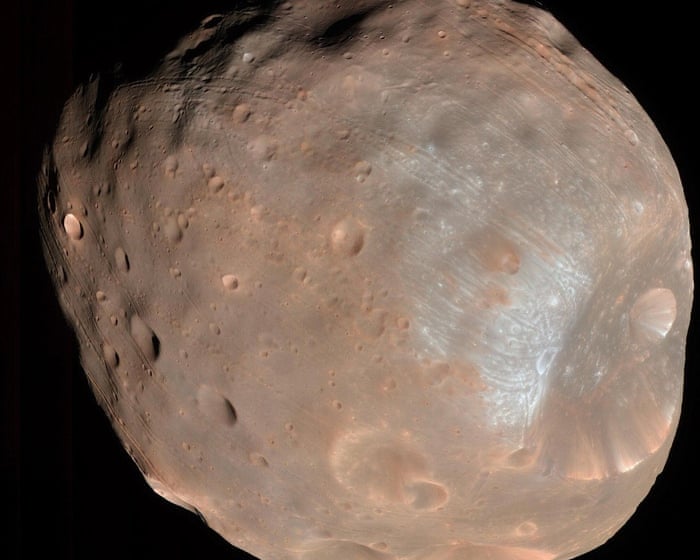
Japan's space agency, Jaxa, is preparing to launch a spacecraft on Tuesday on the first mission anywhere to bring back samples from Phobos, one of the two small, potato-shaped moons of Mars. The Martian Moons eXploration (MMX) mission is expected to last about five years. Scientists hope it will clarify how Phobos and its smaller companion Deimos formed and may even offer clues about the origins of life in the solar system.
The spacecraft is due to lift off on Japan's new H3 rocket. Japan leads the mission, with equipment and communications support from the US space agency Nasa and other national agencies.
Why the moons matter
Project manager Yasuhiro Kawakatsu said the samples would give scientists useful data for judging whether a Martian moon could serve as a base for a future crewed mission to Mars, which the US, China and others hope to carry out. He described the moons as the most important unclimbed mountains in the solar system.
Dozens of missions have gone to Mars since the 1960s, but its moons remain largely a mystery. Several Russian attempts to land on Phobos, including one launched in 2011, failed. Some scientists think the moons are debris left after a large object struck Mars; others believe they are asteroids from elsewhere. Principal investigator Kiyoshi Kuramoto said analysing soil samples should almost certainly settle the question.
Route and sampling
The craft should reach the Mars region around August 2027, spend three years flying near and around Phobos, and return in 2031. MMX has three modules, for propulsion, exploration and return, and only the return module will come home with samples. It carries 13 instruments, including Idefix, a rover developed jointly by France and Germany. Around 2029 the rover will spend 100 days exploring the surface to help pick a landing site.
Jaxa aims to collect at least 10 grams of soil in two sampling attempts, using US and Japanese methods. The samples will return in a heat-protected capsule expected to land in Australia before being sent to Japan.
