95 of 100 Members of Latvia's New Saeima Hold Higher Education Degrees
Data compiled by Latvian Television shows that 95 members of the 15th Saeima have higher education. Economics, business and management are the most common fields of study.
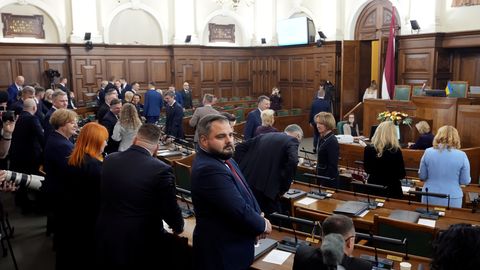
In Latvia's newly elected 15th Saeima, the national parliament, 95 of the 100 members have higher education. This follows from information compiled by Latvian Television and reported by the news portal LSM. Economics, business and management are the most common fields of study, accounting for about a third of all degrees and professional qualifications listed.
Education breakdown
Four members have secondary education, and one has only basic education. Law is the second most widely represented field. The parliament also includes specialists in history, philology, art, music, engineering and other areas.
Seven members hold doctoral degrees: Andris Skride, Edvīns Šnore, Mārtiņš Hirša, Andris Sprūds, Jana Simanovska, Andrejs Judins and Inese Lībiņa-Egnere. Some members added to their education recently: Līga Meņģelsone, Jānis Vitenbergs and Jevgēnija Šafraneka earned degrees this year.
Some members have professions unusual for a parliament. Jānis Urtāns is a ship's navigator, Česlavs Batņa is a conductor, and Andrejs Svilāns is a plant physiologist.
Using knowledge in parliament
Members have said they plan to apply their knowledge in the Saeima's work. Guntars Vītols of the United List, who holds a master's degree in economics, intends to focus on finance and economic issues. Roberts Žemaitis of Latvia First plans to study in depth how the Nord Pool electricity exchange operates. Krista Burāne of the Progressives named culture and nature protection as her priorities.
Experts: a diploma is no guarantee
Political scientist Lelde Metla-Rozentāle believes that widespread economic education could be useful in the current difficult economic situation, as it helps in understanding financial processes. She notes that higher education can broaden one's outlook and analytical skills, but does not in itself guarantee good decision-making.
Political scientist Romāns Gagunovs stresses that a diploma does not automatically provide political competence. In his view, basic knowledge of politics and law is also needed, since much of a legislator's daily work involves reviewing draft laws.