Yemen's Houthis fire missiles at Saudi Arabia after strikes on Sanaa airport
Yemen's Houthi group launched missiles at Abha airport in southwestern Saudi Arabia on Monday, retaliating for air strikes on Sanaa's international airport that they blamed on the kingdom. The Saudi-led coalition said its air defenses intercepted the missiles and no casualties were reported.
Yemen's Houthi rebels said they fired missiles at Abha airport in southwestern Saudi Arabia on Monday in response to airstrikes on Sanaa's airport that they attributed to the kingdom. The Saudi-led coalition in Yemen, which supports the internationally recognized government, reported that its air defenses "dealt with" the incoming missiles and that there were no casualties.
The Houthis, who control northwestern Yemen and are backed by Iran, earlier accused Saudi Arabia of "blatant aggression," claiming it had struck the runway of Sanaa International Airport. The strike was claimed by Yemen's government, which said it aimed to prevent an Iranian plane from landing. This represents the most significant escalation in the largely dormant conflict between the Houthis and Saudi Arabia since an informal truce took effect four years ago.
Yemen has been devastated by a civil war that began in 2014 when the Houthis ousted the government from Sanaa. The conflict escalated in 2015 after a Saudi-led coalition of Arab states intervened to restore the government's rule. The fighting has reportedly killed over 150,000 people and triggered one of the world's worst humanitarian crises, with more than 22 million people in need of aid, according to the United Nations.
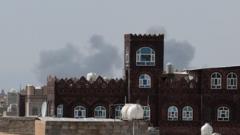
On Monday, social media footage showed plumes of smoke rising over rooftops in Sanaa after the strikes at the airport. The Houthi-run al-Masirah TV said the "departure and landing runways" were targeted. The internationally recognized Yemeni government, based in the southern port city of Aden, said its forces carried out the strikes amid a dispute over the plane used by a Houthi delegation returning from Iran after the funeral of the late supreme leader Ayatollah Ali Khamenei.
"The terrorist Houthi militias, backed by the Iranian regime, prevented Yemeni national aircraft from landing at the airport in the capital, Sanaa, while insisting on allowing an Iranian plane to violate Yemeni territory; consequently, the airport runway was targeted," the Yemeni defense ministry said. According to the Houthis, the Iranian plane had to divert and later landed in the Red Sea city of Hudaydah, about 150 kilometers (93 miles) to the southwest.
Houthi military spokesperson Yahya Saree accused Saudi Arabia of being behind the Sanaa strikes, saying they ended "the de-escalation phase" of their conflict and would not go "unanswered or unpunished." Saudi authorities did not comment on the strikes before Saree announced on Monday evening that the Houthis had launched ballistic missiles and drones at Abha International Airport "in response to this criminal Saudi aggression." He also warned airlines against flying through Saudi airspace "until the blockade on Sanaa International Airport is lifted."
The spokesman for the Saudi-led coalition later wrote on X that "air defenses have dealt with ballistic missile threats launched by the terrorist Houthi militia towards the Southern Region." At an emergency UN Security Council meeting in New York, Assistant Secretary General Khaled Khiari expressed concern. "Yemen and the wider region cannot afford another cycle of escalation," he said. "We call on all actors to constructively engage in negotiations under UN auspices." The UK's UN representative strongly condemned the "reckless Houthi attacks on Saudi Arabia, which threaten regional security." Iran's foreign ministry condemned the attack on Sanaa's airport as a "clear violation of international law."

