A Jupiter-size planet that escaped its star's death
Using the James Webb Space Telescope, astronomers have discovered that the planet WD 1856 b, orbiting a dead star, is unexpectedly hot and contains methane, indicating an unusual migration history.
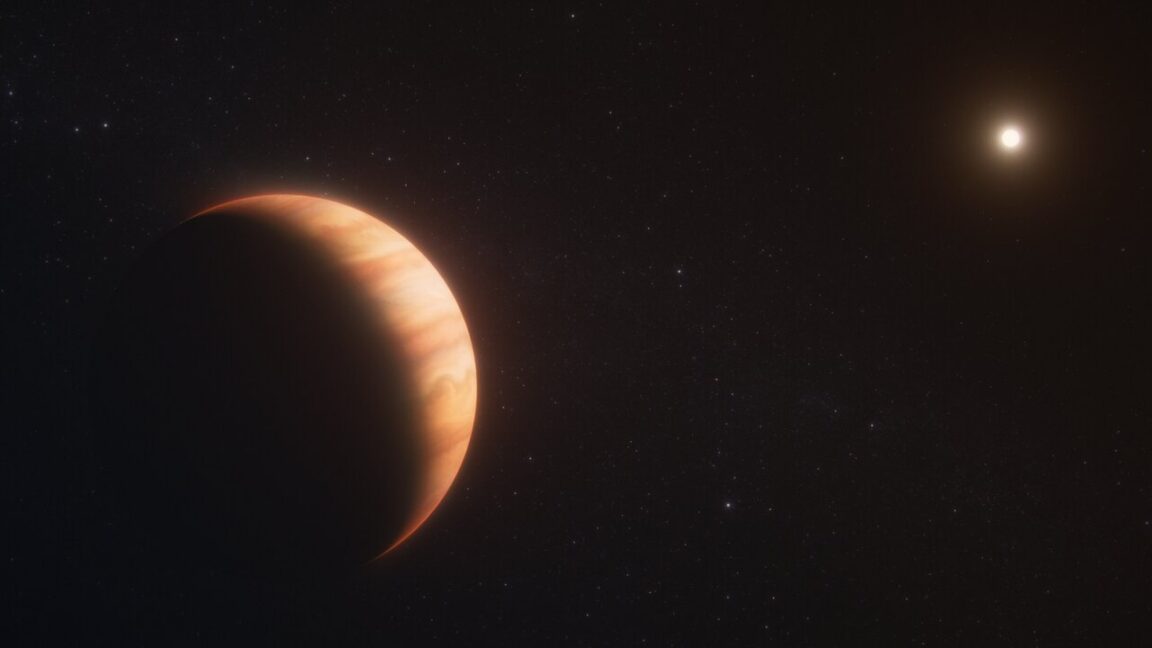
Planet WD 1856 b was already considered unusual—a Jupiter-sized world orbiting a white dwarf, the burnt-out remnant of a Sun-like star. It is the only confirmed planet that survived its star's red giant phase. Now, astronomers have used the James Webb Space Telescope (JWST) to examine the planet in detail for the first time, revealing even more surprising features.
WD 1856 b was discovered accidentally in 2020 when the TESS observatory surveyed about 2,000 white dwarfs in search of small objects like comets or asteroids. Instead, astronomers found a gas giant. The white dwarf is about seven times smaller than the planet. Each time the planet crosses in front of the star, the brightness drops by only about half instead of nearly to zero, which scientists attribute to a grazing transit where the planet only partially obscures the star. Moreover, the planet orbits at just 0.02 astronomical units from the white dwarf—much closer than theories predicted after the star's death.
JWST observations on April 27, 2023, captured a single transit lasting only eight minutes. To analyze the data, the team developed new equations and modified the POSEIDON software for exoplanet atmospheric reconstruction. The results showed that WD 1856 b's atmosphere contains methane and aerosol hazes, with a temperature of about 400 Kelvin—far hotter than expected. The planet emits roughly 25 times more energy than it receives from its cooling host star, indicating an internal heat source rather than stellar heating.
The scientists proposed two scenarios for how the planet ended up so close. The first is a common-envelope model, where the planet was originally in a close orbit and survived being engulfed by the red giant. The second is high-eccentricity migration, where gravitational interactions with companion stars caused the planet to spiral inward over billions of years. Cooling models suggest the reheating event occurred 3 to 5.5 billion years ago—too late for the common-envelope model, favoring the migration scenario.
However, the cooling models assumed a Jupiter-like atmosphere with 0.3% methane, while WD 1856 b has about 7% methane. Since methane is a potent greenhouse gas, this could affect the calculations. The team plans to build new models and conduct further observations. WD 1856 is only 75 light-years away, suggesting that more planetary survivors may be waiting to be found.