Canada and EU launch new 'Alliance for the Future'
Canadian Prime Minister Mark Carney and European Commission President Ursula von der Leyen announced a new Canada–EU partnership in Montreal. The leaders committed to pursuing associate membership for Canada, with its scope to be clarified at a 2027 summit.
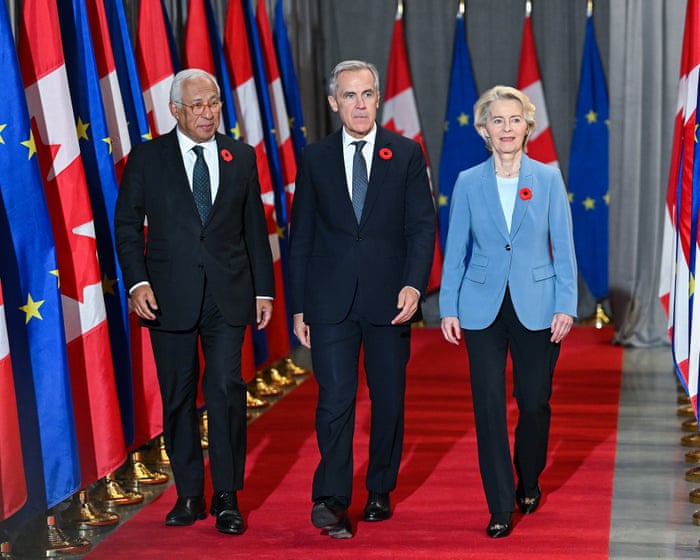
Canada and the European Union announced a new alliance of like-minded nations, called the Alliance for the Future, in Montreal on Friday. Canadian Prime Minister Mark Carney and European Commission President Ursula von der Leyen unveiled it at the end of a two-day summit. The partnership between Canada and the 27-member bloc is presented as a protective shield for citizens and a hedge against unpredictable geopolitics, and other countries are welcome to join.
What the cooperation involves
The leaders said future talks would aim at a more integrated market worth tens of billions of dollars, fewer trade and travel restrictions, and new educational opportunities. Brussels and Ottawa also agreed to bring Canada into Europe's supercomputing network, giving Canada access to European machines for training artificial intelligence models.
Carney pointed to the planned merger of Canadian AI company Cohere and Germany's Aleph Alpha as a step toward reducing reliance on American AI giants. The new company will have dual headquarters in Berlin and Toronto, and Canada's federal government has announced a stake in Cohere worth up to C$1.6bn.
Background: relations with the US
A trade war with the United States has pushed Carney to seek new partners, and heavy reliance on American companies, especially in defence, has given Canada pause. The source reports that Elon Musk throttled Starlink and Starshield speeds over Ukraine in mid-October, severely disrupting Ukrainian military operations.
Associate membership
The leaders again raised the prospect of Canada becoming an associate member. Von der Leyen called the designation uncharted territory. A clearer scope will come at a 2027 summit. Some EU members have bristled at a legally meaningless status they fear could confuse other countries seeking membership. European Council President Antonio Costa called Canada "by far the most European of the non-European countries".
Tension in Quebec
The summit has caused friction in Quebec, where the separatist Parti Québécois recently formed a minority government. Premier Paul St-Pierre Plamondon skipped the event after Ottawa refused to let him speak publicly at it.