China builds vast artificial island for military base in South China Sea in under a year
China has completed the first construction phase of a new artificial island on Antelope Reef in the South China Sea, intended to host warships and combat aircraft. The site sits in disputed waters also claimed by Vietnam and Taiwan.
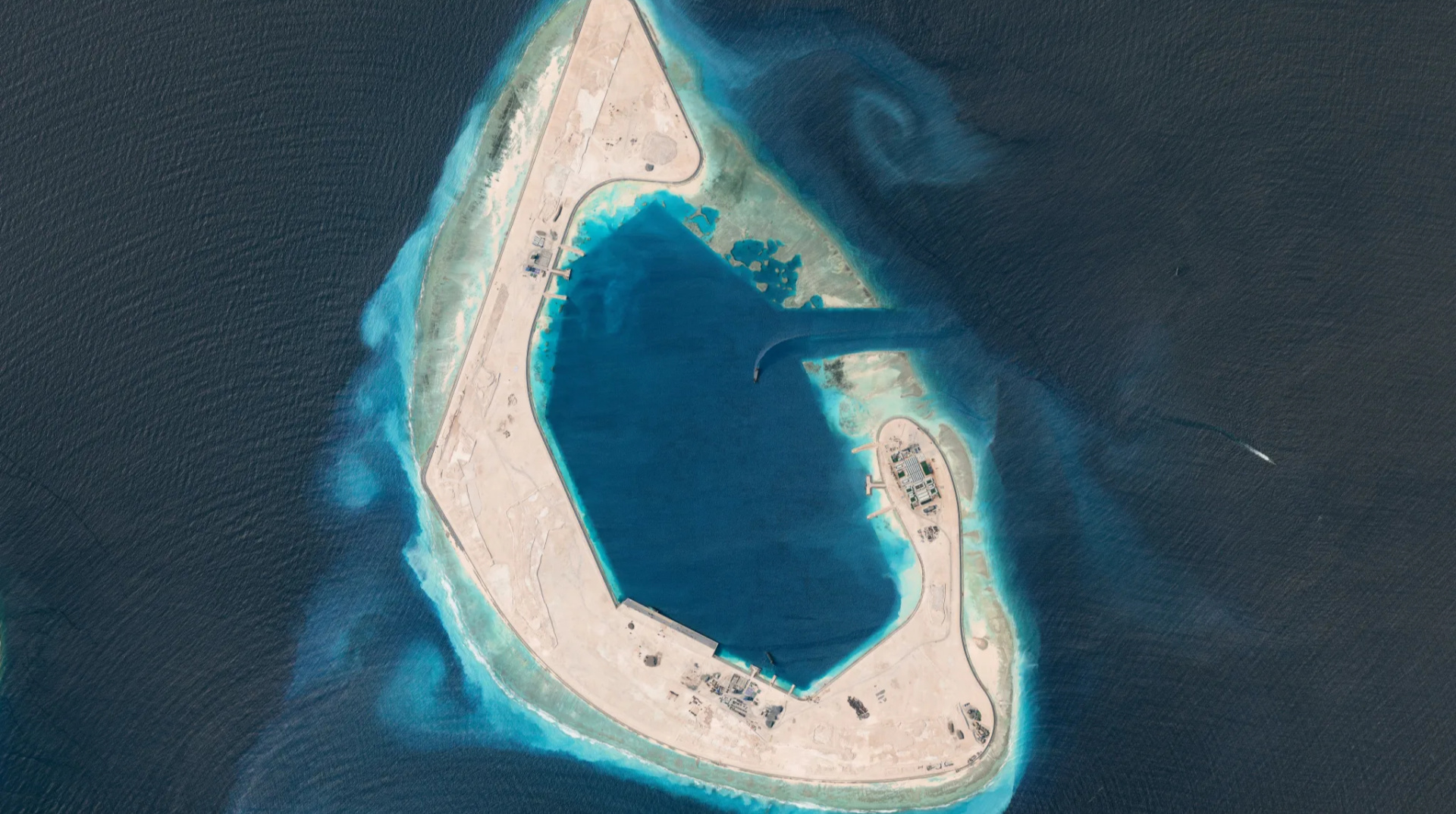
Satellite imagery shows China has finished the first phase of building a new artificial island covering nearly 607 hectares on Antelope Reef in the South China Sea. The report comes from outlet TWZ, citing satellite images from Vantor, data from Reuters, and the Asia Maritime Transparency Initiative (AMTI).
Work began in late 2025, when a fleet of Chinese dredging vessels left the mouth of the Zhujiang River bound for the reef, sailing with transponders switched off to avoid attention. In under a year of round-the-clock work, China raised more than a million tons of sand from the seabed, creating a drop-shaped landmass roughly 6 kilometers long, now ringed by sea walls and internal roads. The main construction fleet has since left the area, signaling the end of the first phase.
Planned infrastructure
On the island's northwestern side, preparatory work is underway for a runway about 3,000 meters long and 55 meters wide, capable of handling large military and commercial aircraft. Analysts also identified a nearby 60-by-60-meter excavation matching the size of large aircraft hangars at other Chinese military bases in the region. In the southern part of the site, a 680-meter pier has been built, where a China Coast Guard vessel has already been spotted. On the eastern side, administrative and residential buildings, a helipad and parking areas are already in use, with two concrete plants supporting further construction.
Strategic significance
Antelope Reef is part of the Paracel Islands, occupied by China since 1974 and still claimed by Vietnam and Taiwan. It lies south of the port of Sanya and the Yulin naval base on Hainan Island, home to two of China's three aircraft carriers and substantial submarine forces. Such artificial islands function as logistics hubs and permanent surveillance posts, reinforcing Chinese control over the South China Sea.
Chinese state media maintain the reef will serve only commercial and civilian purposes — rhetoric that has accompanied every previous artificial outpost built in the region, including after 2015, when Xi Jinping pledged not to pursue militarization. Despite such assurances, Beijing has continued expanding its military presence, in what is widely seen as a violation of the UN Convention on the Law of the Sea (UNCLOS).