Moscow uses 'Russian Houses' in Africa to lure recruits into war in Ukraine, investigation shows
Ukraine's military intelligence reveals that Russia operates 'Russian Houses' across Africa to recruit young people for the war in Ukraine, promising education and jobs but sending them to the front lines.
Ukraine's military intelligence (HUR) has published an investigation showing that Russia is expanding a hybrid network of so-called 'Russian Houses' across Africa to consolidate influence and recruit soldiers for the war in Ukraine. According to HUR, Moscow plans to open such centres in eight African countries: Nigeria, Senegal, Liberia, Sierra Leone, Togo, Mali, Mozambique, and São Tomé and Príncipe.
The centres are run by Russia's federal cooperation agency Rossotrudnichestvo in collaboration with the Centre for Public Diplomacy (CPD), founded in 2024 to expand the network, especially in Africa. Although the EU sanctioned Rossotrudnichestvo in July 2022 for spreading disinformation related to the invasion of Ukraine, it continues to grow its African footprint, operating over 85 official branches abroad.
Inside the Russian Houses, activities include screening Soviet and Russian films, often with patriotic themes, distributing ideologically vetted literature, teaching the Russian language, and coaching young people on how to move to Russia as students or workers. Organizers promote an image of a 'happy Russia,' but HUR says many recruits end up signing contracts with the Russian military and being sent directly to the deadliest front-line sectors in Ukraine.
In 2025, then-head of Rossotrudnichestvo Yevgeny Primakov Jr announced that Russia would fund over 5,000 African students to study in Russia. However, in January 2026, he publicly admitted that a 'well-known African private military company' – widely understood to be the Wagner Group – had been directly involved in establishing Russian Houses in Mali and the Central African Republic, and some of its members had moved into official Russian state positions. Ukraine's Centre for Countering Disinformation called this confirmation that the centres function as elements of hybrid operations rather than neutral cultural institutions.
The Russian House in Bangui, Central African Republic, is run by Dmitry Sytyi, who also controls Wagner's operations in the country and reportedly uses the centre as a logistics hub for gold, diamond, and timber trafficking.
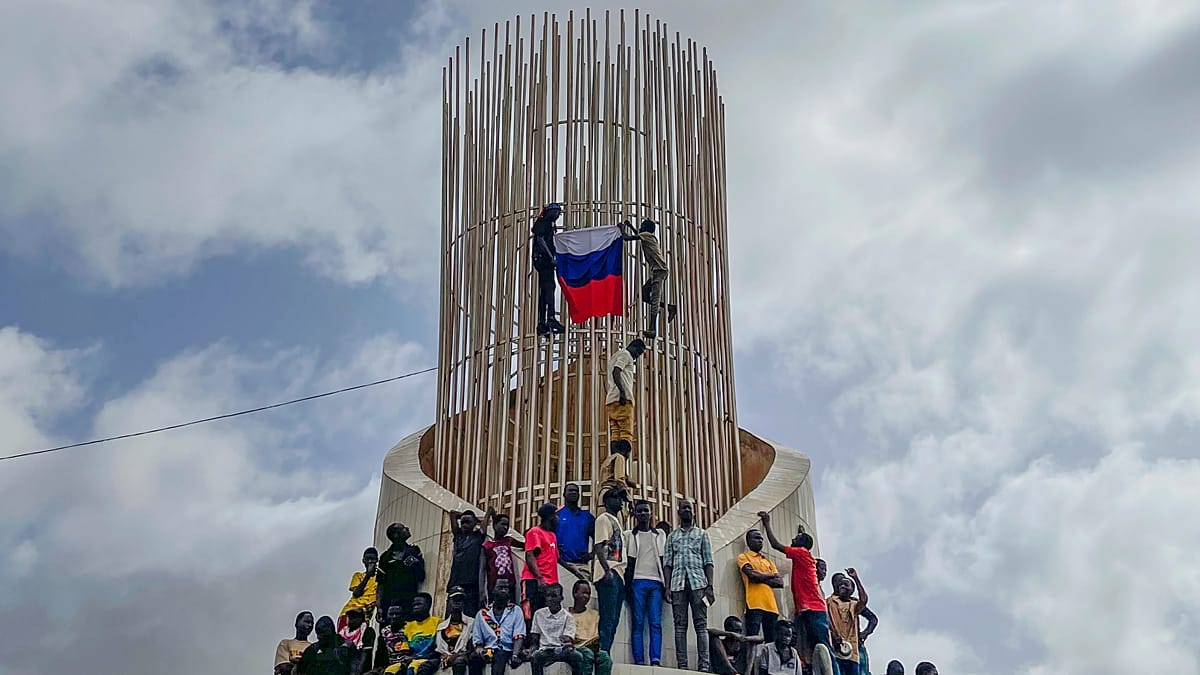
The expansion of Russian Houses has closely followed the rise of pro-Russian military juntas in West Africa: centres opened in Mali in 2022, Burkina Faso in January 2024, and Niger in October 2024, all after coups where Wagner or its successor force Africa Corps became primary security providers. Africa Corps, controlled by Russia's Defence Ministry, is implicated in mass civilian killings and war crimes.
According to a report by the Danish Institute for International Studies (DIIS), Russian information warfare has expanded significantly in the Global South since 2022, especially in Africa. DIIS noted that between June and September 2025, the number of Russian military service promotion posts aimed at foreigners on the VK platform increased from 621 to 4,600. By mid-2025, one in three contract announcements targeted foreigners, compared to 7% in 2024.
The Washington-based Africa Centre for Strategic Studies stated that Russia has built a pipeline funnelling thousands of Africans into the front lines and factories supporting Moscow's war effort. 'These were not the destinations the young Africans thought they had signed up for. Many were looking for jobs, training, or opportunities abroad. Drawn by promises of life-changing salaries, they instead found themselves trapped in a war far from their home countries,' the centre said.
Kenya's National Assembly Majority Leader Kimani Ichung'wah testified in February that recruits are 'basically just given a gun to go and die.' Others are trapped in drone factories such as the Alabuga Special Economic Zone in Tatarstan, which produces Shahed-136 drones. DIIS also revealed that recruitment increasingly targets young African women, especially Nigerian students, to work in drone factories.
Ukraine's Foreign Ministry confirmed in June that at least 2,965 citizens from 36 African countries have fought on Russia's side. The Africa Centre noted that African recruits appear to be assigned to especially expendable battlefield roles.
Not every expansion attempt has succeeded. In September 2024, authorities in Chad arrested Russian operatives immediately after the opening ceremony of a planned Russian House in N'Djamena, a rare instance of government intervention against Russia's efforts to harden its presence.
Several African states, including Kenya, Ghana, and Nigeria, have repeatedly demanded explanations from Moscow and called for an end to the illegal recruitment of their citizens, but the Russian foreign ministry has continued to ignore those demands. When asked about the deceptive recruitment, Kremlin spokesperson Dmitry Peskov denied involvement, stating in May that 'We are unaware of any such cases.'