Russia's Duma election ends without real opposition as ruling party leads
Russia's three-day State Duma election concluded Sunday, with the ruling United Russia party leading early counts while most anti-war candidates had been barred from running. The Kremlin is framing the vote as proof of public support for the war in Ukraine.

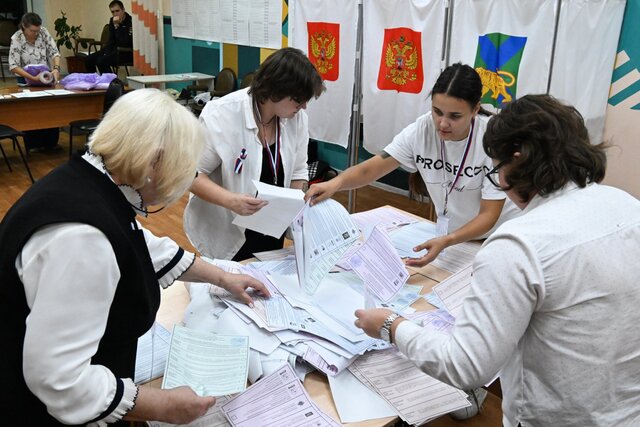
Polling stations closed across Russia's 11 time zones on Sunday evening, ending a three-day State Duma election — the first since the full-scale invasion of Ukraine began in February 2022. Initial results were expected Sunday night, with a fuller picture due Monday.
After processing the first protocols, Russia's Central Election Commission reported United Russia leading with 57.54% of the vote, followed by the Communist Party at 13.67%, the LDPR at 9.27%, New People at 7.96%, and A Just Russia at 5.16%. Turnout was approaching 57% by Sunday afternoon. In the previous election in 2021, United Russia won more than two-thirds of the Duma's 450 seats. President Vladimir Putin is not a party member and did not run this time, though the party consistently backs his policies.
Opposition sidelined
The election took place in a tightly controlled political environment. Most prominent anti-war candidates were excluded from the ballot, and many of Putin's critics remain imprisoned or in exile. The liberal Yabloko party, which has publicly opposed the war, was removed from the federal party list by Russia's Supreme Court in August, though some of its candidates were allowed to run in single-mandate districts. Yabloko said one of its election observers in St. Petersburg lost consciousness during detention and reported other cases in which its observers were denied access to polling stations.
Tied to the war
Ahead of the vote, Putin explicitly linked the election to the war in a televised address, calling on voters to demonstrate support for Russian soldiers. The Kremlin is positioning the results as evidence of public backing for what it continues to call a "special military operation," though independent assessment of public sentiment remains difficult given the limited political competition and repressive environment.
Voting also took place in Russian-controlled parts of Ukraine's Donetsk, Luhansk, Kherson and Zaporizhzhia regions, which Ukraine and most of the international community reject as illegal. Images from the occupied areas showed election officials accompanied by armed Russian soldiers. Electronic voting, used by Putin himself, was expanded further in this election despite long-standing criticism from opposition figures and independent observers over its lack of transparency. Disruptions to the electronic system were reported during voting, which officials attributed to widespread cyberattacks.