Latin America's mega-prisons: can El Salvador's model work elsewhere?
More than a dozen Latin American governments have proposed building mega-prisons modeled on El Salvador's CECOT to fight organized crime. Experts consulted by Deutsche Welle question whether such projects would be effective and sustainable.
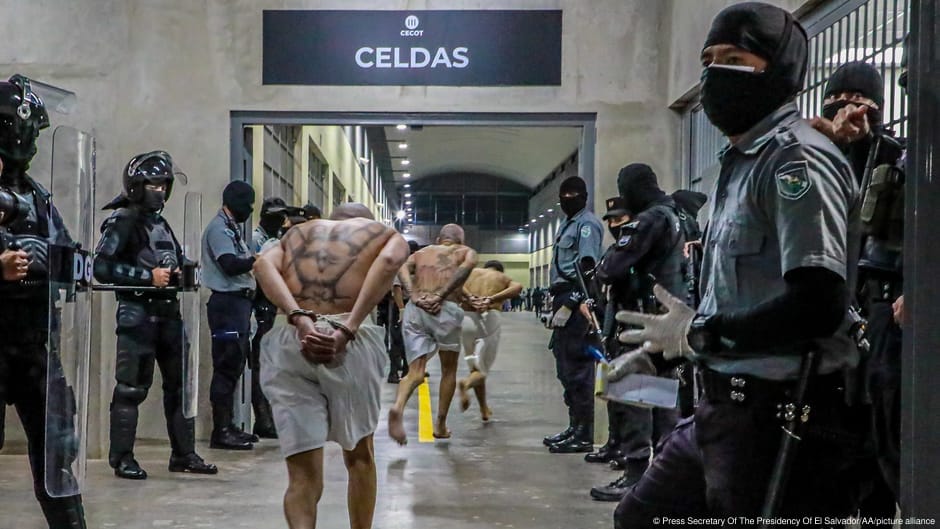
More than a dozen governments in Latin America have proposed building so-called mega-prisons to combat organized crime. The template is El Salvador's Terrorism Confinement Center (CECOT), which has operated since 2023 and has become a symbol of President Nayib Bukele's security policy. Most of the planned facilities would be far smaller. Experts consulted by the German broadcaster Deutsche Welle doubt that such initiatives would be effective or sustainable.
What is a mega-prison
Criminologist Jose Luis Perez Guadalupe, a former head of Peru's National Penitentiary Institute and former interior minister, notes that overcrowded prisons existed in the region long before Bukele. Lima's Lurigancho Prison, designed for 3,000 inmates, has held nearly 11,000 for decades. Since CECOT opened, however, the term has mainly come to mean maximum-security facilities.
Olga Espinoza, an academic at the University of Chile's School of Government, argues that holding the entire prison population under such severe conditions would be inefficient and very costly. These prisons need heavy investment in infrastructure, technology, staff and reintegration programs. Mixing inmates with different profiles also raises the risk of criminal behavior spreading. Several of the region's criminal groups, including Tren de Aragua in Venezuela and PCC and Comando Vermelho in Brazil, have roots in overcrowded prisons.
Renato Rivera, an analyst at the Global Initiative Against Transnational Organized Crime, says there is not enough evidence that mega-prisons are more cost-effective. Perez Guadalupe recalls that UN rules adopted in 1955 recommend medium-sized prisons holding 1,000 to 2,000 inmates. As an example of the danger, Rivera cites the 2021 prison massacres in Ecuador's largest facilities.
Security and human rights
The experts acknowledge that mass incarceration in El Salvador has coincided with a sharp fall in violence and has strengthened the public's sense of safety. At the same time, there have been reports of arbitrary arrests, abuses and more than 500 deaths in state custody. Perez Guadalupe calls the Salvadoran model "pure propaganda."
Alternatives
The experts point to the UN Nelson Mandela Rules and to regional approaches such as Brazil's APAC model, which runs prisons without guards or weapons. Maximum-security prisons, they say, are needed only for specific inmates and on a smaller scale. Prisons deal with the consequences of organized crime rather than its causes, so employment and education policies are also required.