Ukrainian artist Manzhos: country lacks standards for visual culture
Ukrainian artist Volodymyr Manzhos discusses why tasteless monuments keep appearing in Ukraine's public spaces, touching on murals, education and art's role during wartime, including the controversial Shakespeare statue in Poltava.
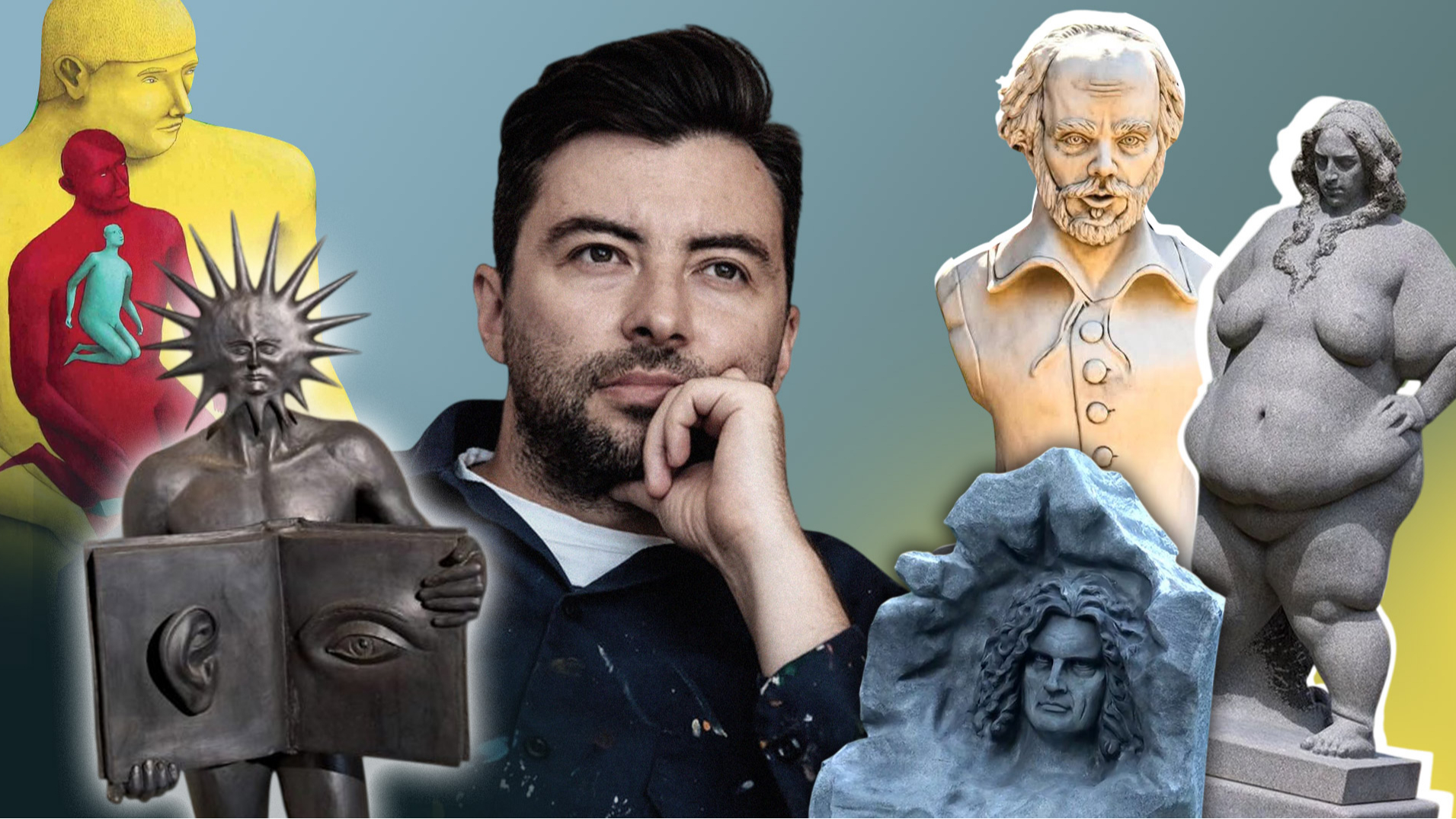
Ukrainian artist Volodymyr Manzhos, known by his stage name WaOne, spoke to Ukrainska Pravda about the state of visual art in Ukraine's public spaces, referencing the controversial Shakespeare monument in Poltava, created within seven days by sculptor Yaroslav Shkarupa.
Manzhos admits his first reaction upon seeing the statue was laughter, followed by more painful feelings and the question of why such works appear at all. He notes that during the years of war, demand for various visual gestures, including murals, has surged in society — a trend that at one point led Kyiv authorities to ban murals altogether and later introduce an approval procedure involving experts.
Cultural vacuum and gaps in education
The artist explains that before the war, artists and art connoisseurs lived in their own cultural "bubble" with shared values. During the war, many of them left the country or fell silent, opening space for anyone willing to create large-scale, brash works. Manzhos stresses that Ukraine lacks a unified system for judging the quality of cultural projects, linking this to gaps in education — unlike France, where students regularly visit exhibitions and museums, Ukraine retains a Soviet-inherited "literature-centric" education system that pays insufficient attention to visual art and design.
He also cites several replicas of the Eiffel Tower found around Kyiv as evidence of an inferiority complex — a tendency to copy Western examples rather than create original work. However, he says attitudes toward local art have shifted considerably during the war: while his 2014 mural about the Maidan events drew criticism, his recent work receives near-unanimous support.
Manzhos also created Ukraine's first mural as part of the duo Interesni Kazki and has produced works in several countries, including Spain, Mexico and Denmark, often gaining recognition abroad before being noticed at home.
/nginx/o/2026/09/16/17921566t1hf355.jpg)