'Crime scene' Black Sea: how the war is poisoning waters and reshaping land
Odesa hydrobiologist Vladyslav Balinskyi describes how Russian strikes on civilian ships, repeated oil spills and the destruction of the Kakhovka dam have caused ecological damage around the Black Sea that will be felt for decades.
A cargo ship under fire
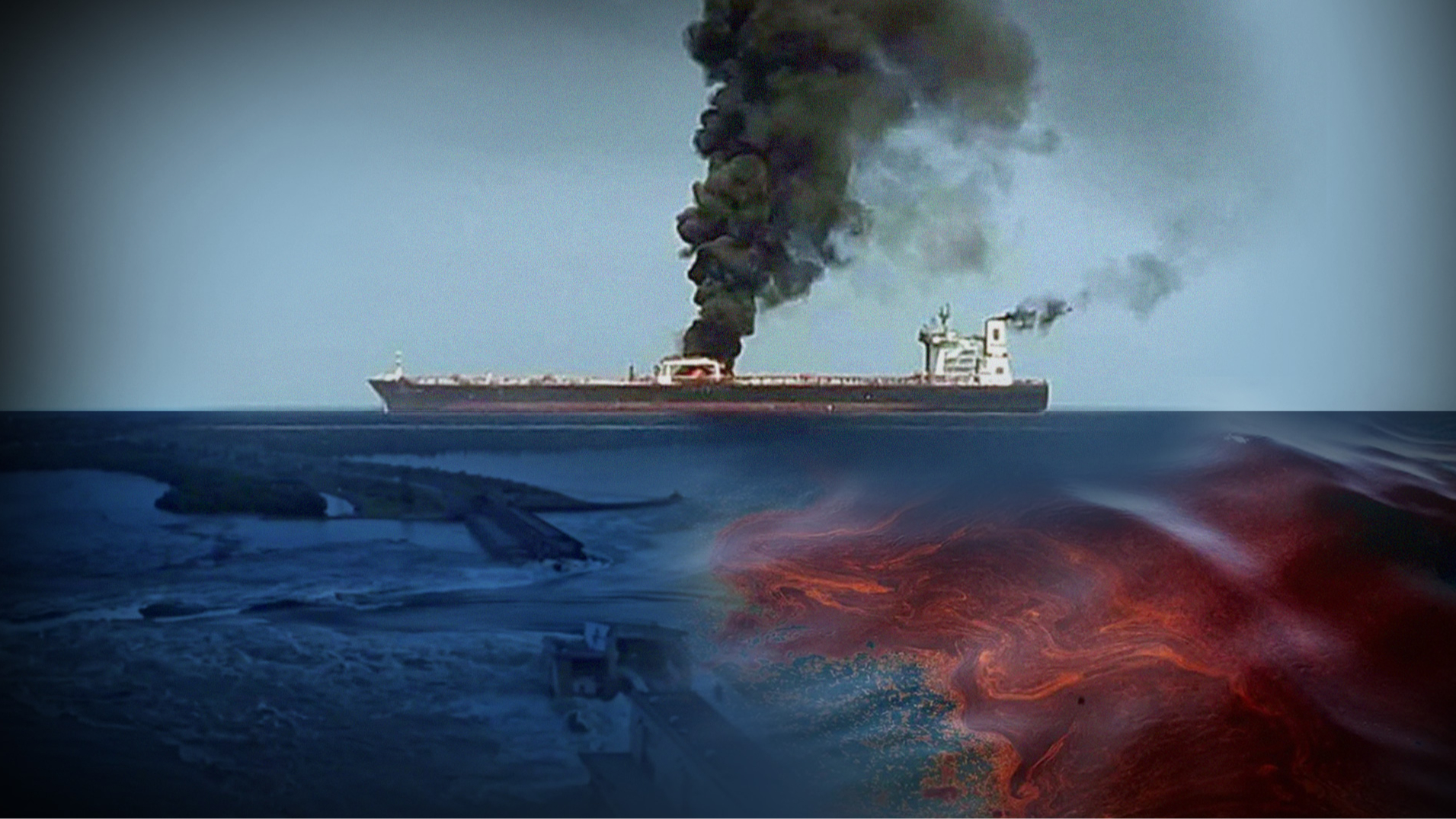
On 19 July 2026, Russian cruise missiles struck the cargo vessel Golden Leo, sailing under the flag of Guinea-Bissau after loading corn at the port of Chornomorsk near Odesa. Three missiles were fired, including one after rescuers had already arrived; ten people died, among them a Ukrainian harbour pilot, while eight crew members were evacuated to hospital. A week later the ship capsized and sank in Odesa Bay at a depth of roughly 22–24 metres, with its grain cargo still aboard, raising fears of a fuel leak and of decaying grain damaging seabed ecosystems.
The attack was witnessed by Vladyslav Balinskyi, a researcher at the Tuzla Lagoons National Park and head of the Odesa branch of Ukraine's National Ecological Center, who has spent years documenting the war's environmental toll. Russia has opened a criminal case against him and placed him on an international wanted list, officially over alleged "fakes" about its army, though he believes the real reason is his professional work, including his involvement in investigating the Kakhovka dam's destruction.
Oil and fuel spills
Balinskyi contrasts Russian strikes on civilian ships with Ukrainian strikes on "shadow fleet" tankers, which typically disable a vessel without sinking it, whereas repeated Russian strikes often sink ships and cause worse pollution. He has counted at least four major pollution incidents in the past two years, the latest in April this year after a strike on Chornomorsk port released tons of sunflower oil. In December 2024, a similar attack spilled vegetable oil that formed a roughly 60-square-kilometre slick along the Odesa coast and killed birds; experts consider such oil in some respects more harmful than fuel oil. Fuel spills remain a separate threat: in December 2024, two Russian tankers broke apart in a storm in the Kerch Strait, and this year, as the sea warmed, fresh fuel oil releases from their wrecks have been tracked by satellite reaching the Tuzla Lagoons park some 600 kilometres away.
The Kakhovka disaster and marine life
Balinskyi calls the 2023 destruction of the Kakhovka dam the war's most painful environmental blow, as the draining reservoir washed freshwater animals and mountains of debris into the sea. Three years on, the former reservoir bed, known as the Great Meadow, has begun regenerating with forests and meadows. Since 2022, nearly 100,000 dolphins are estimated to have died in the Black and Azov seas, with 56 dead animals found near the park in June alone — threatened not only by chemical pollution but by military sonar and explosions that disrupt their echolocation.
Damage invisible on land
Balinskyi says the least documented consequence is what is happening to soil along the front line, where phosphorus munitions burn away the fertile humus layer and its ecosystem. He warns these areas will likely be unable to recover naturally after the war, facing desertification instead.