METR Report: AI Is Substantially Speeding Up AI Research at Anthropic
The independent research group METR has found that AI development at Anthropic has run about twice as fast over the past year as in the year before. The author of an analysis of the report argues that Anthropic's own "dramatic acceleration" threshold has likely already been crossed.
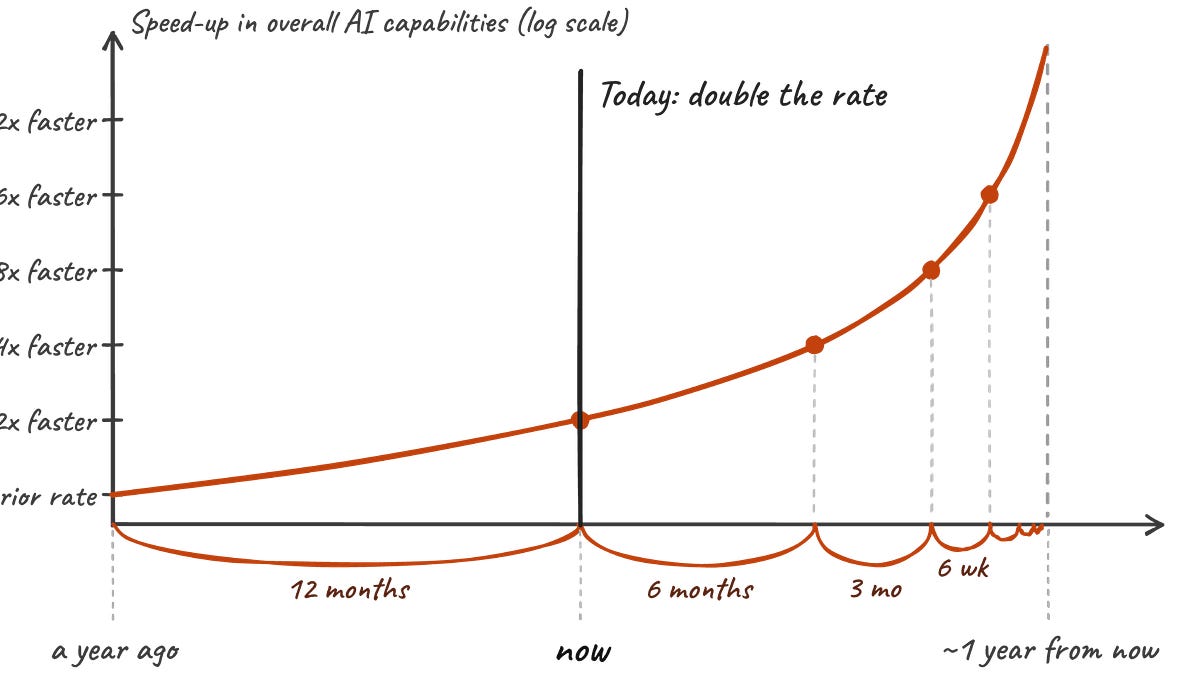
An AI safety researcher at METR has published an analysis of a public METR report on the acceleration of AI research at Anthropic, the company that develops the Claude AI models. The report's authors conclude that between October 2025 and October 2026, progress in AI capabilities at the company ran roughly twice as fast as in the preceding twelve months. The analysis's author notes that he did not work on the project and has not seen the full, unredacted version of the report.
Which threshold is at stake
In its S1 filing (the registration document for a public share offering), Anthropic wrote that it may soon meet the "dramatically accelerated progress" threshold defined in its Responsible Scaling Policy (RSP). The policy says this happens when overall capabilities progress runs at least twice as fast as the fastest sustained pace seen when AI contributed little to AI research, and when this can plausibly be attributed to research automation rather than more compute or other inputs. Based on the report and the policy text, the author concludes the threshold has most likely already been reached.
The acceleration was measured with AECI, Anthropic's internal version of the Epoch Capabilities Index. The report's authors estimate that roughly 80% of the current speed-up is attributable to AI. Much of the supporting evidence in the report has been redacted.
What it means for researchers
The author calculates that for overall progress to double, the productivity of research labor would need to rise by far more, possibly around 10 times. That is in line with informal estimates from Anthropic staff, who say internal models give them roughly a 12-fold uplift. The METR authors found no evidence of bottlenecks that would halt compounding acceleration.
Safety concerns
The author argues that such a trajectory demands very strong protection of model weights and algorithms, along with monitoring and governance mechanisms, and says the industry is not currently at that level. He also regrets that much of the underlying evidence is redacted, leaving readers to rely on trust.