Mike Nelson returns to his crumbling desert shack at Oxford, now bleaker than ever
British artist Mike Nelson has rebuilt his 2004 installation of a decaying shack swallowed by sand dunes for a major new show at Modern Art Oxford, using it to reflect on a world he sees as having only grown darker since.
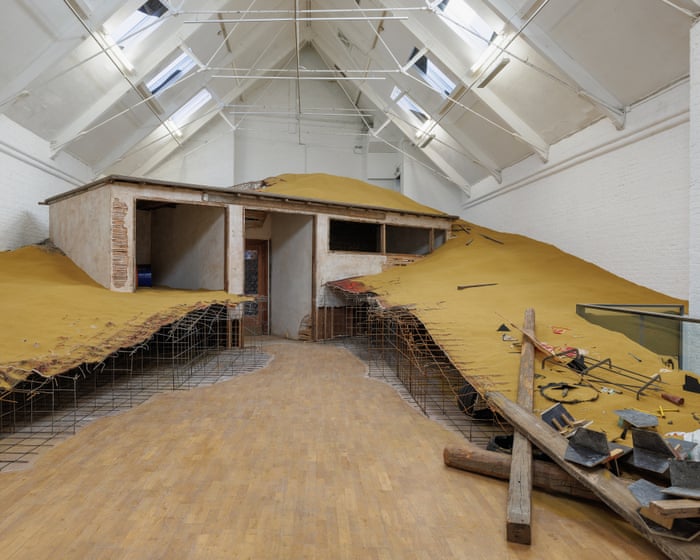
British artist Mike Nelson has unveiled an ambitious new exhibition at Modern Art Oxford, returning to a work he first showed at the same gallery in 2004: a dilapidated shack being consumed by a desert dune. The structure has been rebuilt in the same space, but now appears more weathered and broken. The dune itself is presented differently too, revealed as an illusion — a thin layer of sand propped up by carpets and a rusted metal frame rather than a genuine mound.
In the first gallery, Nelson has also recreated his old studio, but stripped of the materials and tools that once filled it, leaving empty shelves. A projector cycles through slides of self-portraits beside a broken mirror and a human skull, pointing to an unusually introspective and personal tone for the artist.
A world that has only grown worse
Revisiting the piece 22 years after it was first made, during the early days of the Iraq war, Nelson compares that period with the present. The exhibition opens against a backdrop of wars in Iran, Sudan, Ukraine, Israel and Gaza, authoritarian leaders holding power, and conspiracy theories gaining wide acceptance. Nelson's conclusion is that conditions have not improved but deteriorated — the shack is now strewn with socialist party pamphlets and broken crucifixes, suggesting shattered beliefs.
One side gallery has been turned into a locked bedroom containing only a metal cot and shelves of travel books, where visitors can only imagine escape rather than achieve it. Elsewhere, large sculptures resembling a cross between a skull and a conch shell evoke the idea of a desert island, hinting at isolation as the only perceived way out of societal turmoil.
The spaces are linked by a narrow mining-shaft passage leading to a cinema-foyer-like area where most doors lead nowhere. Reviewers have described the show as among the clearest and most personal of Nelson's career, framing it as a reflection on how his outlook has shifted from hope toward profound despair over the past two decades.