MIT Scientists Reprogram Immune Cells to Fight Cancer Inside the Body
Researchers at the Massachusetts Institute of Technology have developed a method that uses nanoparticles to turn natural killer cells into cancer fighters directly in the body. So far it has been tested only in mice.
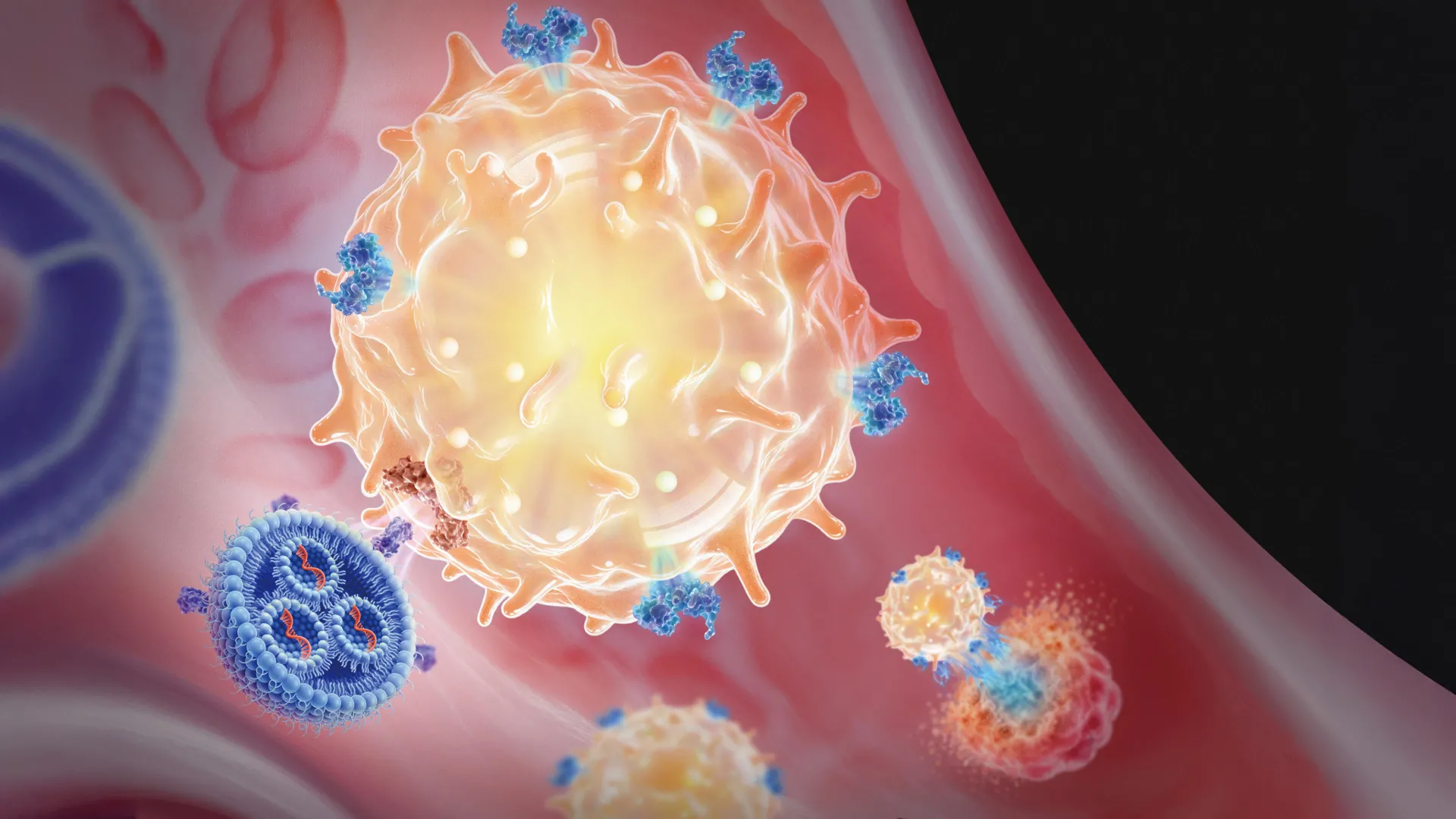
Scientists at the Massachusetts Institute of Technology (MIT) have developed a technique for converting natural killer (NK) cells, a type of immune cell, into cancer-fighting cells directly inside the body. The study was published in Nature Biotechnology. If the approach works in people, engineered immune cell therapies could become far simpler and cheaper to produce and give. For now, experiments have been carried out only in mice.
How the method works
Conventional cell therapies involve removing immune cells from a patient, modifying them genetically in a lab and returning them. The new approach instead uses tiny lipid nanoparticles to deliver messenger RNA (mRNA) to NK cells, instructing them to make a special receptor. The resulting cells are called CAR NK cells. The particles are coated with antibody fragments that attach to receptors on NK cells. The receptor can be adapted to different targets, such as CD19, a protein on B cells, or CD3, a protein on T cells.
NK cells were chosen partly because they can be directed at diseased T cells without destroying one another, a problem that arises with CAR T cells. This matters for T cell lymphoma and autoimmune diseases. The US Food and Drug Administration has approved seven CAR T cell therapies in the past decade, but no CAR NK therapy has been approved.
Results in mice
After the nanoparticles were injected, about 80 percent of the targeted NK cells were modified. In mice with an aggressive melanoma, three of the five treated animals achieved complete remission. In humanized mice, which carry human blood cells, with T cell lymphoma, tumors were completely eliminated after five injections, with results comparable to lab-made CAR NK cells.
In autoimmune hepatitis, where faulty T cells attack liver cells, a single injection eliminated those T cells, and the mice's damaged liver tissue healed.
Next steps
The researchers hope to adapt the method for multiple sclerosis and rheumatoid arthritis. Senior author Daniel Anderson is a professor at MIT. Further research is needed to determine whether the technique is safe and effective in humans. The work was funded by Sanofi, the Marble Center for Cancer Nanomedicine and the US National Cancer Institute.