NASA's Swift space telescope set for uncontrolled re-entry after two decades in orbit
NASA's Neil Gehrels Swift Observatory, launched in 2004 to study the most powerful explosions in the universe, is expected to re-enter Earth's atmosphere on 4 November. An attempt to lift it to a higher orbit last year failed.
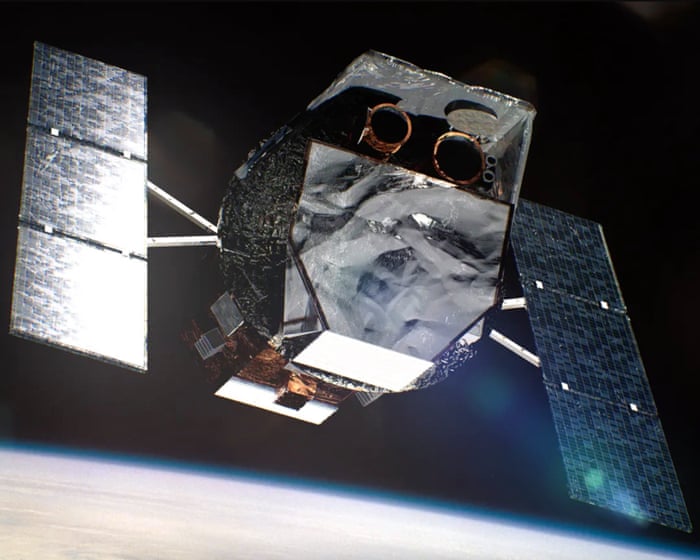
NASA's Neil Gehrels Swift Observatory, which has spent two decades studying the most powerful explosions in the universe, is expected to fall uncontrolled into Earth's atmosphere within hours and mostly burn up. The US Space Force predicts the 3,200lb (about 1,450kg) satellite will hit the atmosphere at roughly 3.30am Eastern time on 4 November. The telescope can no longer steer or carry out observations.
What is known about the re-entry
NASA says most of the spacecraft should burn up, though some components are expected to survive. Any surviving fragments would land between 20.6 degrees south and 20.6 degrees north latitude. The agency puts the risk of harm to anyone on Earth at about 1 in 2,100, which it calls unlikely. NASA and the Space Force will keep monitoring the re-entry and updating their predictions.
Last year NASA tried to push Swift into a higher orbit with the help of a private space contractor, but the mission failed when the spacecraft did not manage to rendezvous. Last month the observatory was estimated to be 171 miles above Earth, and it was commanded to end operations in preparation for re-entry.
Two decades of science
Swift was launched in 2004 under NASA's medium explorer (Midex) program to study cosmic gamma-ray bursts and quickly relay their location and strength to Earth. It detected and tracked more than 2,000 such bursts, which are considered the most powerful explosions since the big bang. They occur about once a day, last from a few milliseconds to a few hundred seconds, and their cause is unknown. Scientists have suggested they could mark the birth of a black hole in a massive stellar explosion or the collision of two neutron stars.
In July, Swift observed a wandering supermassive black hole shredding a star, known as a tidal disruption event. A paper in The Astrophysical Journal Letters said the event outshone its entire host galaxy in ultraviolet light, radiating like about 10 billion suns. How the black hole drifted so far from the galactic centre remains unknown.
NASA says Swift broadened understanding of active galaxies, stellar X-ray flares, supernovae, and comets and asteroids in the solar system.