NATO deploys AWACS airborne radar aircraft to Poland after Russian missiles crash
After three Russian H-101 cruise missiles crashed in Poland on 20 November, NATO has forward-deployed an AWACS early warning aircraft. The alliance has operated such flying radar platforms since 1982.
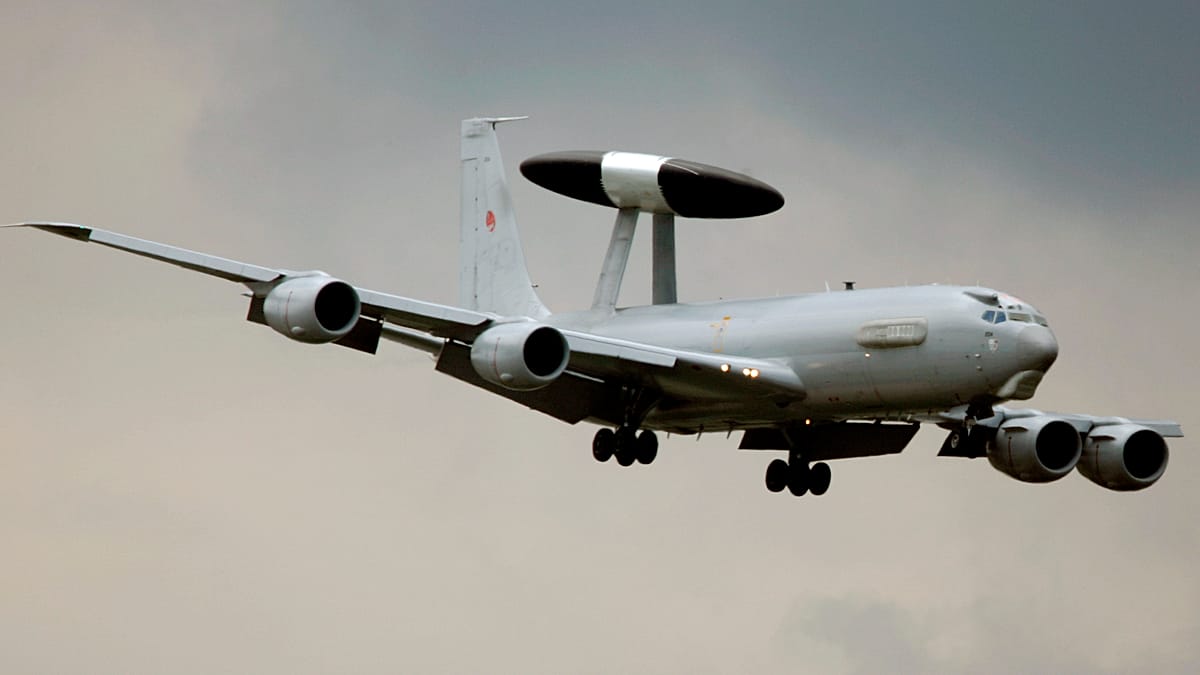
NATO has sent an AWACS airborne surveillance and control aircraft to help monitor Polish airspace. General Alexus Grynkewich, the commander of NATO's European forces, authorised the forward deployment, which the alliance confirmed on 23 November. The decision came three days after three Russian H-101 cruise missiles crashed in Poland on 20 November, according to the Polish prosecutor's office.
AWACS stands for airborne early warning and control system. NATO flies Boeing E-3 Sentry aircraft, best known for a rotating radar dome of about nine metres in diameter mounted above the fuselage. Because it operates at altitude, the radar sees farther than a ground-based one, which can lose low-flying aircraft or cruise missiles behind the Earth's curvature and terrain. The crew cross-checks detections against other sources to identify and track air traffic, then passes the resulting air picture to fighter jets, ships and ground control centres. Units from several countries can therefore follow the same situation and coordinate their response. The fleet is based in Gelsenkirchen, Germany, and since 2022 it has monitored the airspace over NATO's eastern flank.
Earlier missions
NATO received its first E-3s in 1982. After Iraq invaded Kuwait in 1990, they were sent to eastern Turkey. From 1992 they watched the airspace of the former Yugoslavia, helped enforce the no-fly zone over Bosnia and Herzegovina, and were deployed during the 1999 Kosovo crisis.
After the terrorist attacks of 11 September 2001, seven NATO AWACS aircraft flew to the United States at Washington's request. The Eagle Assist operation involved 830 military personnel from 13 allied countries and more than 360 sorties up to May 2002. The aircraft were also used in Libya in 2011, in Afghanistan from 2011 to 2014, and from 2016 in the coalition against Islamic State.
Replacement
At NATO's summit in Ankara in July, eleven allies announced a joint purchase of Saab GlobalEye aircraft to replace part of the ageing E-3 fleet. The Swedish radar will be fitted to a Canadian Bombardier aircraft, and NATO says the new system will monitor land and sea movements as well as airborne targets.
In a border incident, the time between first detection and the alert matters, as does whether the Polish control centre and an allied fighter pilot see the same picture. A flying radar can help with both.