Odesa ecologist: Russian strikes on ships cause more marine damage than Ukrainian attacks on tankers
Odesa hydrobiologist Vladyslav Balinsky describes how the war is devastating the Black Sea ecosystem, from oil and vegetable oil spills to nearly 100,000 dead dolphins and irreversible soil damage along the front line.
Vladyslav Balinsky, an Odesa-based hydrobiologist and head of the Odesa branch of Ukraine's National Ecological Centre, has spent years documenting how Russia's war against Ukraine is damaging the Black Sea ecosystem. He personally witnessed a July attack on the cargo ship "Golden Leo," struck by three Russian cruise missiles near Odesa, killing ten people including a Ukrainian pilot. A week later the ship capsized and sank in Odesa Bay with grain still in its holds, raising pollution concerns.
Oil spills at sea
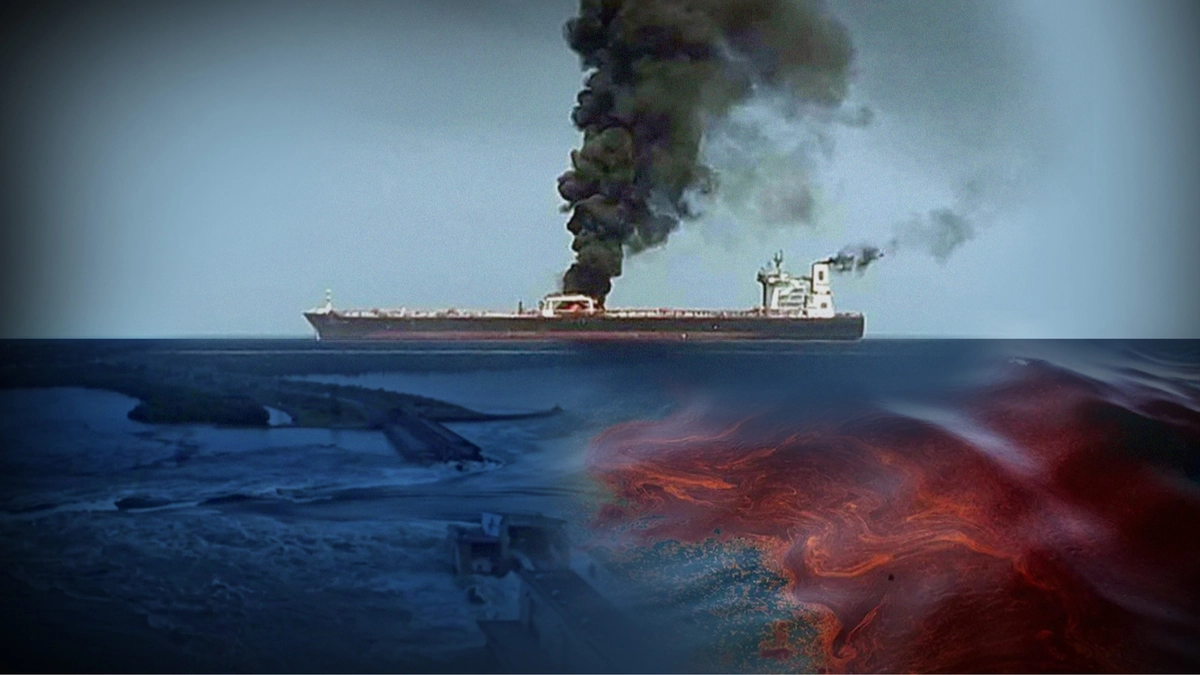
Balinsky says he has recorded at least four major pollution incidents in the past two years. Last December, a Russian strike on vegetable oil storage tanks caused a 60-square-kilometer slick along Odesa's coast, killing birds and prompting volunteers to rescue survivors. He notes that vegetable oil can be even more environmentally damaging than fuel oil in some respects. Additional risk comes from Russia's practice of transporting fuel through the Sea of Azov via small tankers, and from two tankers that broke apart in the Kerch Strait in December 2024 — their wrecks are still leaking fuel oil this year, with slicks reaching the Tuzla Estuary National Park 600 kilometers away.
The Kakhovka dam disaster and dolphin deaths
Balinsky calls the 2023 destruction of the Kakhovka hydroelectric dam the war's most severe environmental consequence, saying its impact on the Dnipro-Buh estuary ecosystem is irreversible, though flooded areas are gradually regrowing with forests and meadows. Since 2022, nearly 100,000 dolphins have died in the Black and Azov seas, partly because military sonar and explosions disrupt their echolocation. The sea is also littered with drone debris, mines and munitions, which will require demining before the seabed can be cleaned after the war.
Invisible damage to the land
Less documented, Balinsky says, is the damage phosphorus munitions cause to soil along the front line, destroying the fertile humus layer and the organisms living in it and altering the soil's structure itself. Without human intervention, these areas are unlikely to recover naturally and will most likely turn into desert.

/nginx/o/2026/09/22/17930971t1h278a.png)