The Fall of Orders: From Zelenskyy to Haile Selassie
After the scandal of stripping Zelenskyy of a Polish order, a Czech politician suggested revoking the Order of the White Lion. Among the recipients of these orders are Catherine II, Mussolini, and Haile Selassie, whose warning to the League of Nations in 1936 went unheeded.
The scandal over the revocation of Volodymyr Zelenskyy's Polish Order of the White Eagle and the "order fall" of other Ukrainian politicians has gained a sequel. A representative of the Czech party "Freedom and Direct Democracy" (SPD), Jindřich Rajchl, proposed that President Petr Pavel follow the Polish example and deprive Zelenskyy of the Order of the White Lion. Although the initiative seems unrealistic, the "war of orders" has sparked interest in the history of these awards.
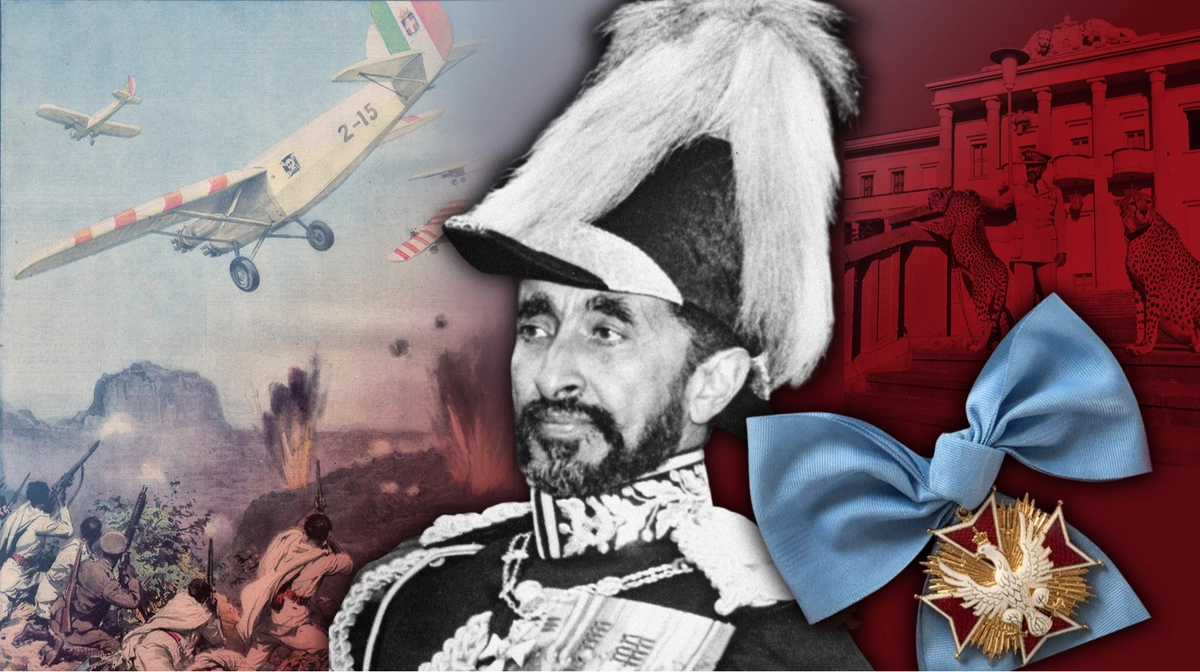
Among the knights of the Order of the White Eagle unexpectedly appear Russian Empress Catherine II, Hitler's allies Miklós Horthy and Benito Mussolini (who also received the White Lion), and pro-Putin German Chancellor Gerhard Schröder. Even more intriguing is the Emperor of Ethiopia, Haile Selassie I, whose ceremonial uniform was adorned not only with both orders but also dozens of others.
Ninety years ago, in June 1936, Haile Selassie delivered a historic speech from the podium of the League of Nations in Geneva: "Today it is we. Tomorrow it will be you." He tried to convince the world that Italy's attack on Ethiopia was not a local conflict but an assault on the system of collective security. But no one listened.
Haile Selassie was the tenth child in the family of a provincial governor. At baptism, he received a name meaning "Power of the Holy Trinity" and considered himself a descendant of King Solomon and the Queen of Sheba. He had no formal education—his only teacher in childhood was a French Jesuit. At 13, he began his career as a minor official; at 14, he became governor of a province; at 24, heir to the throne; and at 38, emperor.
He implemented reforms: banned the slave trade, abolished the "lebashai" method (children were drugged to point out criminals, who then had their hands and feet cut off), replaced quartering with firing squad, and introduced Ethiopia's first airplane, car, electricity, printing press, newspaper, bank, and constitution.
On October 3, 1935, the Italian fascist army invaded Ethiopia. Mussolini sought revenge for the defeat in the First Italo-Ethiopian War. The Ethiopian army was poorly prepared—soldiers went into battle wearing silver and gold ornaments, and the emperor ordered them removed. The Italians used chemical weapons, spraying poisonous rain from aircraft. Haile Selassie personally led his troops.
In May 1936, Addis Ababa fell, and the emperor went into exile. His appeal to the League of Nations was ignored—sanctions against Italy did not include oil, coal, or metal, and the Suez Canal remained open. Later, Mussolini admitted that if sanctions had included oil, Italy would have been forced to withdraw within eight days.

/nginx/o/2026/10/07/17960479t1he863.jpg)