Rotterdam and Antwerp-Bruges remain the EU's busiest ports by cargo volume
EU ports handled around 3.4 billion tonnes of goods in 2024, with Rotterdam ranked far ahead as the busiest port followed by Antwerp-Bruges, according to Eurostat. The Netherlands also topped the ranking of countries by total cargo volume.
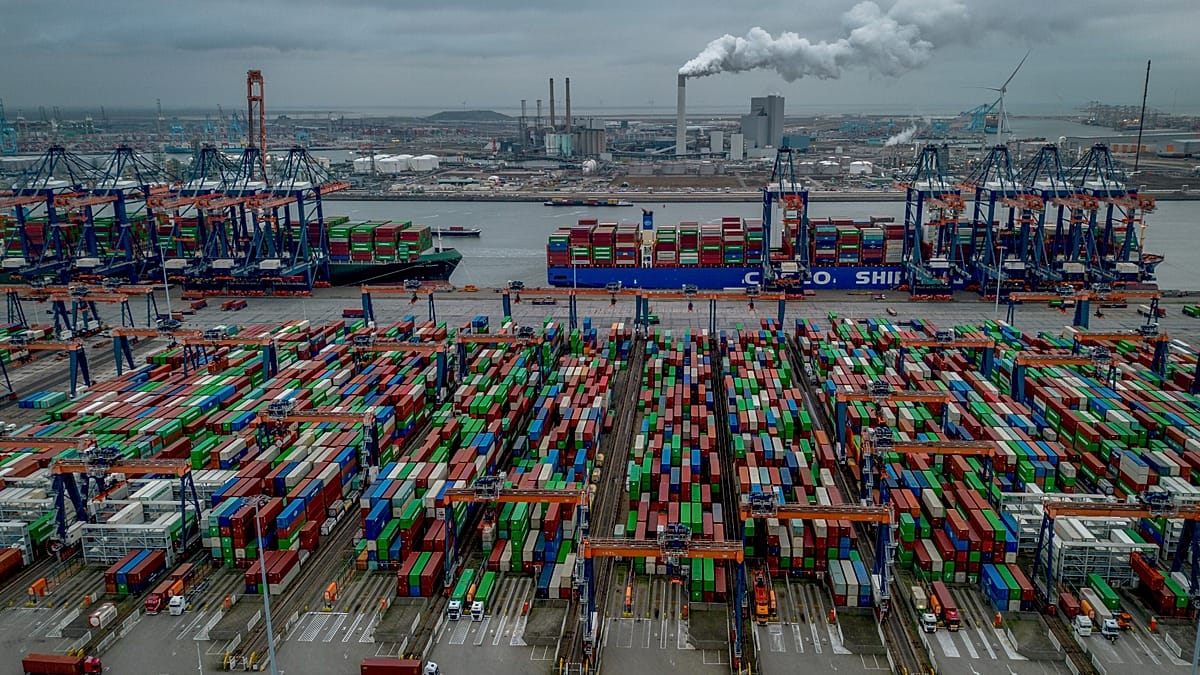
Sea transport remains central to moving goods across Europe. Globally, around 13 billion tonnes of goods were shipped by sea in 2024, of which EU ports handled about 3.4 billion tonnes — 26% of the world total. The EU Blue Economy Observatory notes that nearly 90% of the bloc's external freight trade travels by sea.
Rotterdam and Antwerp-Bruges far ahead of the rest
According to Eurostat figures for 2024, Rotterdam in the Netherlands is by far the EU's busiest port, handling 397.3 million tonnes of goods. Antwerp-Bruges in Belgium ranks second with 243.7 million tonnes. Hamburg in Germany takes third place, though with a notably smaller volume of 97 million tonnes. Spain's Algeciras follows in fourth place with 81.5 million tonnes, and Amsterdam rounds out the top five with 78.8 million tonnes.
The rest of the top ten includes France's HAROPA grouping (Le Havre and Rouen) with 76.6 million tonnes, Poland's Gdansk with 71 million tonnes, France's Marseille with 66 million tonnes, Spain's Valencia with 64.5 million tonnes, and Romania's Constanta with 57.6 million tonnes.
Among ports ranked 11th to 20th, volumes range from 36.8 million tonnes in Dunkerque, France, to 55.5 million tonnes in Barcelona, Spain. This group also includes Italy's Trieste (53.5 million tonnes) and Genova (47.4 million tonnes), Portugal's Sines (44.1 million tonnes), Greece's Piraeus (43.7 million tonnes), Germany's Bremerhaven (42.5 million tonnes) and Sweden's Göteborg (38.5 million tonnes).
Netherlands leads among countries
When totalling cargo across all ports by country, the Netherlands leads the EU with 538.1 million tonnes. Italy ranks second at 488.6 million tonnes, closely trailed by Spain at 486 million tonnes. Belgium takes fourth place with 274.9 million tonnes, followed by Germany with 273.9 million tonnes and France with 269.8 million tonnes. Greece, Sweden and Poland each handled more than 100 million tonnes.
When EU candidate countries and EFTA members are factored in, Turkey moves into second place overall with 524.7 million tonnes, while Norway ranks eighth with 212.1 million tonnes.
The European Commission has described maritime transport as a longstanding catalyst for economic development and prosperity in Europe. In March 2026, it adopted two strategies aimed at boosting competitiveness, sustainability, security and resilience across the EU's wider waterborne sector, covering ports, shipping and shipbuilding.


