A century-late memorial for the deadliest wreck in New York subway history
The 1918 Brooklyn train derailment killed nearly 100 people but wasn't formally memorialized for a hundred years. The crash site can still be viewed today from the Franklin Avenue shuttle and street level.
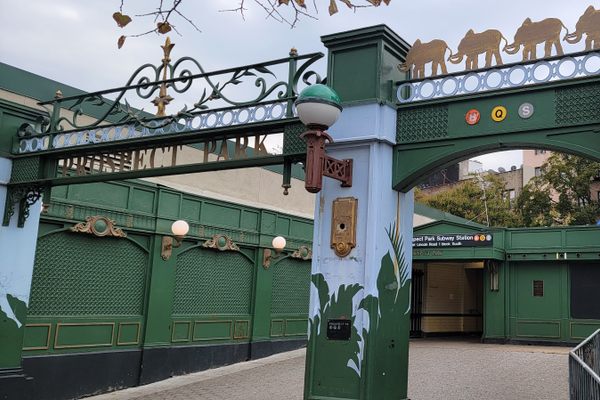
On November 1, 1918, Brooklyn was the scene of the worst catastrophe in New York City subway history and the deadliest train crash in New York State's history. The privately owned Brooklyn Rapid Transit company was running wooden cars over 30 years old on a route between Park Row in Manhattan and Brighton Beach in Brooklyn. Nearly 100 people died in the crash—an exact count was never determined—and roughly 250 of the passengers, about half of those aboard, were injured.
On the day of the accident, the motormen's union was on strike, so the company put crew dispatcher Antonio Edward Luciano at the controls, a man with less than three hours of classroom training and only limited experience moving non-passenger trains. He had already worked a ten-hour shift, was recovering from influenza, and had buried his second daughter three days earlier, one of the many victims of the 1918 flu pandemic.
At the junction of Fulton and Franklin streets, a blown fuse meant the train wasn't recognized as Brighton Beach–bound, forcing Luciano into an eight-minute detour in the wrong direction before he could get back on course. That delay may explain why he skipped a stop and was driving faster than normal to make up time. Approaching a curve with a six-mile-per-hour speed limit, he was traveling roughly five times that speed. The first car's rear wheels derailed entering the tunnel, hurling the following cars into a concrete wall that tore off their roofs and sides.
Organized rescue efforts didn't begin for 45 minutes, since the wreckage was largely hidden from view, delaying word reaching police and firefighters. No one faced criminal charges, though civil lawsuits eventually forced the company into bankruptcy. Within a month, the city renamed Malbone Street to Empire Boulevard, erasing even the name's association with the disaster. It wasn't until 2019, a full century later, that an official plaque was installed at the Prospect Park station to mark the tragedy.
/nginx/o/2026/09/26/17940180t1h5b71.jpg)