Dutch authorities seize 26 critically endangered turtles from passenger bound for Hong Kong
The Netherlands Food and Consumer Product Safety Authority (NVWA) said 26 critically endangered Vallarta mud turtles were found in a passenger's luggage at Amsterdam's Schiphol Airport. The man, who was flying to Hong Kong, remains in custody.
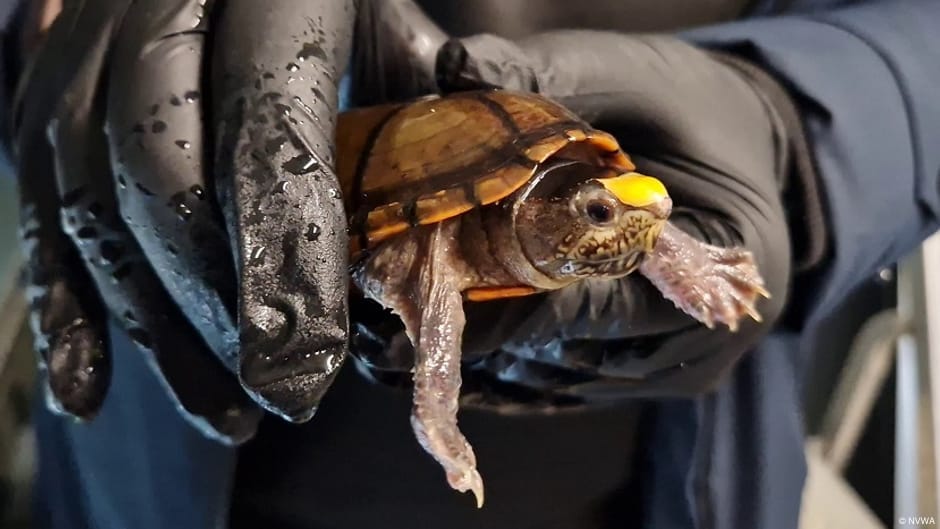
The Netherlands Food and Consumer Product Safety Authority (NVWA) announced on Friday that customs officers at Amsterdam's Schiphol Airport had found more than two dozen critically endangered turtles in a man's luggage. The passenger was flying to Hong Kong via Schiphol. The animals are Vallarta mud turtles, a species found only in Mexico, and illegal trade threatens its survival.
How the animals were found
Customs officers found the turtles on 21 November during a routine inspection. Once they realised the animals were alive, they notified the NVWA as the agency responsible for such cases. Police then arrested the man at the agency's request. In its Friday statement, the NVWA said he was still in custody and that federal prosecutors were continuing their investigation.
Most of the turtles were packed in a box next to a toy car, while others were placed in a sealed sock inside a suitcase. The animals had been wrapped in duct tape, which stopped them from moving. All of them survived the journey. They are now housed at a specialised rescue facility, where the tape was carefully removed and they are receiving the care they need.
What Vallarta mud turtles are
The species is an exceptionally small freshwater turtle, formally described only in 2018 and found in a small area of western Mexico. Relatively little is known about it, both because of its recent discovery and because urbanisation and growing tourism in the state of Jalisco have damaged its habitat. Turtle Island, an organisation in Graz, Austria, which recently began breeding the turtles as a genetic reservoir for possible rewilding, estimates that over 99% of their natural habitat has been lost. The animals do not grow longer than 10 centimetres.
The International Union for Conservation of Nature (IUCN) Red List classifies the species as critically endangered, and it receives the highest level of protection under CITES, the Convention on International Trade in Endangered Species of Wild Fauna and Flora. The NVWA estimates that only about 300 remain in the wild, so the suspected poaching of 26 may have cut the population by nearly 10%. The agency urged the public to report suspected illegal trade in protected animals or plants, including on online forums, marketplaces, bird fairs and antique markets.