Spanish Museum Builds Cray-1 Supercomputer Replica From 30 Old Mac Minis
Spain's Museo de Historia de la Computación has unveiled a 1:1 scale visual replica of the 1976 Cray-1 supercomputer, powered by 30 Mac Minis from 2012. The cluster reached 1.3 teraflops in its latest tests.
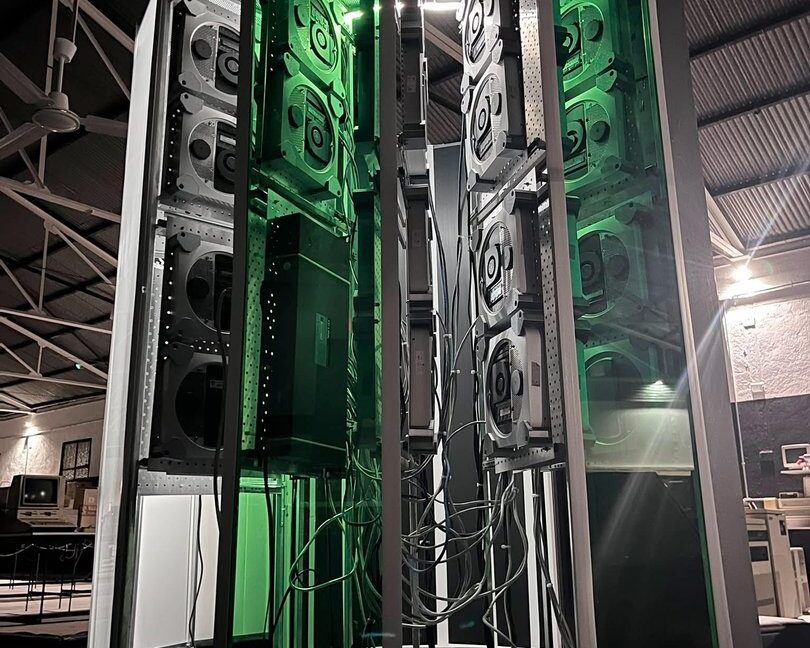
The Museo de Historia de la Computación, a computing history museum in Spain, has unveiled a visual replica of the famous 1976 Cray-1 supercomputer at 1:1 scale. Rather than using costly, cutting-edge components, the team built it around 30 Mac Mini computers, mostly from 2012. The project took 18 months and serves as a 50th-anniversary tribute to both the Cray-1 and the founding of Apple.
Performance and makeup
Networked together, the machines combine 64 active processor cores and reached 1.3 teraflops in the most recent tests. The museum reportedly achieved 1.5 teraflops earlier, when all 70 cores were available, before one node went offline. Benchmarks used a custom Python script for matrix multiplication.
Five of the computers are quad-core i7 models, and the other 25 are dual-core i5 units. Two date from 2014; the rest are from 2012.
Two different architectures
The replica helps visitors understand how computer architecture has changed since 1976. The original Cray-1 used vector processing, applying a single instruction to several data elements at once. The replica instead spreads work across independent processors in a parallel cluster. The original's peak theoretical performance was roughly 160 megaflops, so the consumer hardware is now far more capable.
For software, the team chose macOS Mojave (10.14) over a more typical Linux distribution, because the system has built-in support for MPI (Message Passing Interface), the software layer that lets cluster nodes hand tasks to one another.
Visitors can watch the system run matrix algorithms in real time, seeing performance scale from a single core to the whole cluster working in parallel.
A quiet cooling solution
Cooling was another engineering challenge. The team used passive convection cooling, with a steel rack chassis and aluminum tray mounts for each Mac Mini, which leaves the cluster nearly inaudible.