Trump's remarks on united Ireland may be aimed at audience back home
During his visit to Ireland, US President Donald Trump said he would like to see the island unified, sparking surprise and speculation about his true intentions. Analysts suggest the comments could be targeted at American voters ahead of the upcoming midterm elections.
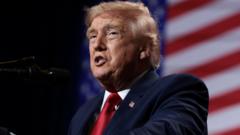
US President Donald Trump's two-day visit to Ireland took an unexpected turn when he told reporters at a press conference that he would love to see Ireland unified. The remark sent ripples through Ireland and Great Britain, leaving it unclear whether it signalled a shift in US foreign policy or was simply an off-the-cuff answer from a president known for engaging freely with journalists.
Former Republican Congressman Mick Mulvaney, who served as Trump's special envoy to Northern Ireland during his first term, cautioned against reading too much into the comments, stressing that the US remains committed to the Good Friday Agreement. Democratic Congressman Brendan Boyle echoed this, noting that support for the agreement enjoys bipartisan backing that is unlikely to change.
A short time later, speaking to an audience of Irish and Irish-American business leaders at the US Ambassador's residence, Trump repeated his comments on unification, again making it one of the first points he raised. The speech, originally billed at 20 minutes, ran roughly twice that long and largely drifted into domestic US topics, including immigration enforcement and defence production.
A message for American voters?
The report suggests Trump's comments may have been directed less at the Dublin audience and more at Americans watching from home, given the fast-approaching November midterm elections, in which the Republican Party faces pressure over control of Congress. Roughly one-tenth of the US population identifies as having Irish heritage, though this group is not a unified voting bloc — many have shifted between the two major parties in recent elections.
The piece draws a historical parallel to former President Bill Clinton, who won significant support among Irish Americans by pledging to engage with the Northern Ireland peace process, a commitment that later contributed to the Good Friday Agreement. Observers note, however, that both the Irish-American community and US politics generally have become considerably more polarised since then.
/nginx/o/2026/09/11/17910621t1h8d01.jpg)