Trump awards Artemis II astronauts nation's highest space honor
US President Donald Trump on Friday presented the Congressional Space Medal of Honor to the four Artemis II astronauts who flew around the moon in April. At the Houston ceremony, Trump also announced plans for a new US space academy.
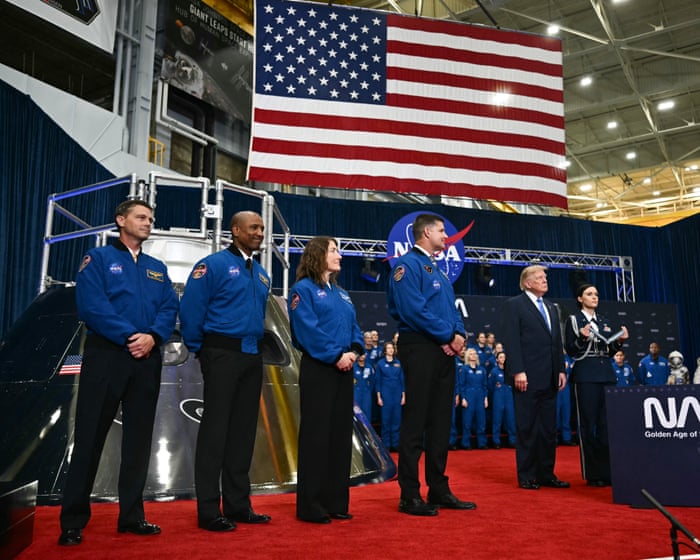
On Friday, a ceremony was held at Houston's Johnson Space Center where US President Donald Trump awarded the Congressional Space Medal of Honor — the nation's highest space honor — to the four astronauts of the Artemis II mission. The recipients were commander Reid Wiseman, pilot Victor Glover, mission specialist Christina Koch, and Canadian astronaut Jeremy Hansen.
In April, the crew became the first astronauts in more than fifty years to travel toward the moon, testing the new Orion capsule and coming within about 6,545 kilometers of the lunar surface — a new distance record for humanity. They were also the first to launch aboard Nasa's new moon rocket, which had previously flown only once.
The ceremony was attended by Nasa administrator Jared Isaacman, who described the astronauts as fitting ambassadors to the stars. Trump announced plans to establish a new space academy serving the Space Force, Nasa, and the commercial space industry, though its location has not yet been decided. The president expressed confidence that Americans would return to the lunar surface before the end of his second term, adding that Mars would be the next target.
The Artemis II flight lays the groundwork for next year's Artemis III docking rehearsal in Earth orbit, while Artemis IV could see two astronauts land near the moon's south pole as early as 2028.
Only 30 astronauts have received the medal to date, including several posthumous honors for those who died in connection with spaceflight. Neil Armstrong was the first recipient, while the most recent before the Artemis II crew were Doug Hurley and Bob Behnken, honored by President Joe Biden in 2023.
Nasa plans to build a sustainable base near the moon's south pole, where permanently shadowed craters are believed to hold frozen water deposits. Nasa deputy administrator Matthew Anderson said a "second space race" has begun, noting that China is eyeing the same lunar region.