Ukraine's Fully Autonomous Drones Killed Russian Soldiers in a Test
According to the CEO of a Ukrainian drone manufacturer, fully autonomous drones killed Russian soldiers in a battlefield test two years ago. The one-time experiment highlights ethical and practical challenges of lethal autonomous weapons.
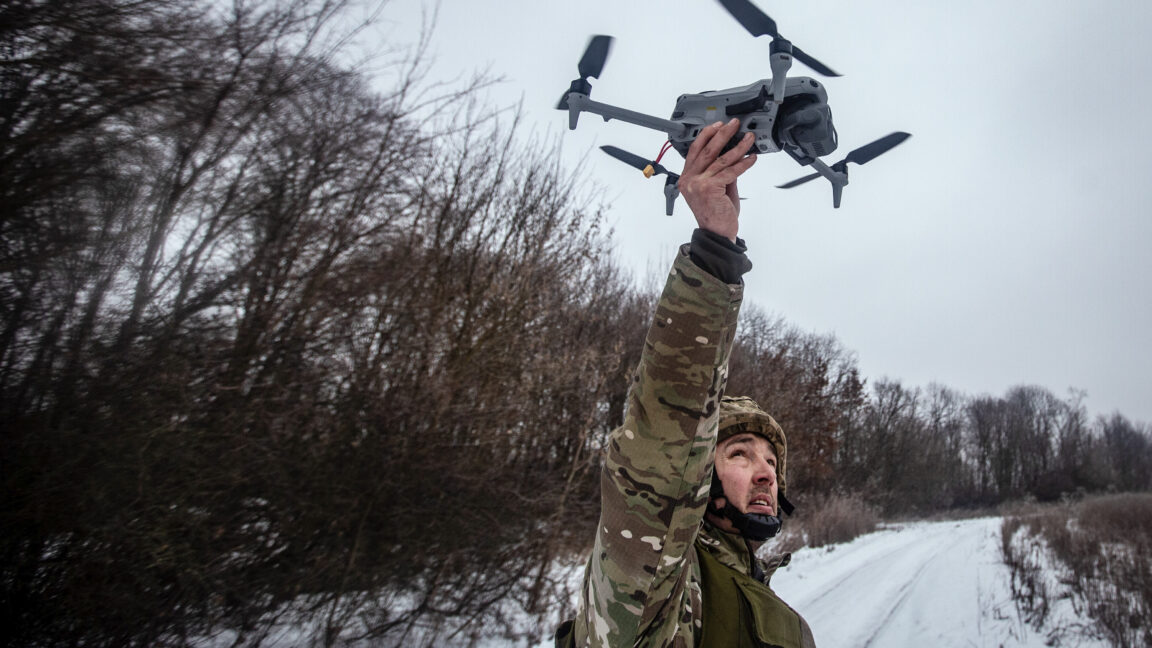
Fully autonomous drones killed Russian soldiers during a battlefield test two years ago, according to Alexander Kokhanovskyy, CEO of Ukrainian drone maker Aero Center, in an interview with New Scientist. If true, the incident marks another milestone in a war that has spurred rapid development in military drones, robots, and AI-guided weapons.
Kokhanovskyy described a test using quadcopter drones preprogrammed to fly to a front-line area and activate an AI-powered “Terminator mode” that would seek out and attack any target in that area without human intervention. After the mission, human-piloted drones found several dead Russian soldiers, attributed to the autonomous drones.
However, a Ukrainian military commander told New Scientist that his drone pilots only use semi-autonomous systems where humans make critical control decisions. He emphasized Ukraine's commitment to international humanitarian law and careful decision-making to prevent civilian casualties.
The one-time nature of the test makes sense given practical limitations and international humanitarian law concerns. Sending fully autonomous drones to attack anything in a given area requires careful planning and risks friendly fire or civilian casualties. It is also unclear how effective these drones were compared to human pilots.
According to the United Nations Office for Disarmament Affairs, there is no commonly agreed definition of lethal autonomous weapon systems. The US Department of Defense defines them as weapons that, once activated, can select and engage targets without further human intervention.
Kateryna Bondar, a former advisor to the Ukrainian government, wrote in a CSIS report that fully autonomous weapons capable of independent operation in complex environments are not yet a battlefield reality in Ukraine. However, a growing number of drones integrate autonomous capabilities for navigation and targeting while humans maintain overall control.
Both Ukraine and Russia field FPV drones for scouting and strikes. Russia's Shahed drones, used in nightly attacks, are typically preprogrammed for automatic flight. Some variants, like the Geran-2, are equipped with Nvidia Jetson Orin microcomputers for autonomous target recognition and retargeting.
Ukraine has deployed low-cost interceptor drones that can autonomously fly to intercept points and lock onto targets, but human operators still perform initial target selection and can cancel attacks. Ukraine's Ministry of Defense states that Ukraine can launch over 5,000 drone strikes per month against Russian targets at ranges exceeding 20 km. These drones rely heavily on autonomous navigation due to Russian electronic warfare and GPS jamming. According to Bondar, AI-driven navigation has increased Ukrainian drone strike success rates from 10–20% to 70–80%.
Ukraine's defense industry focuses on training small AI models on small datasets to run on cheap chips. This has created AI software for autonomous functions like navigation and target recognition, which can be packaged as standalone hardware modules for installation on small FPV drones, long-range strike drones, or even gun turrets of uncrewed ground robots.