Uzbekistan seeks City of London expertise for new financial centre
Uzbekistan is building closer ties with the City of London as it establishes the Tashkent International Financial Centre, which will operate under English common-law principles. The move aims to attract foreign investment and strengthen international business confidence.
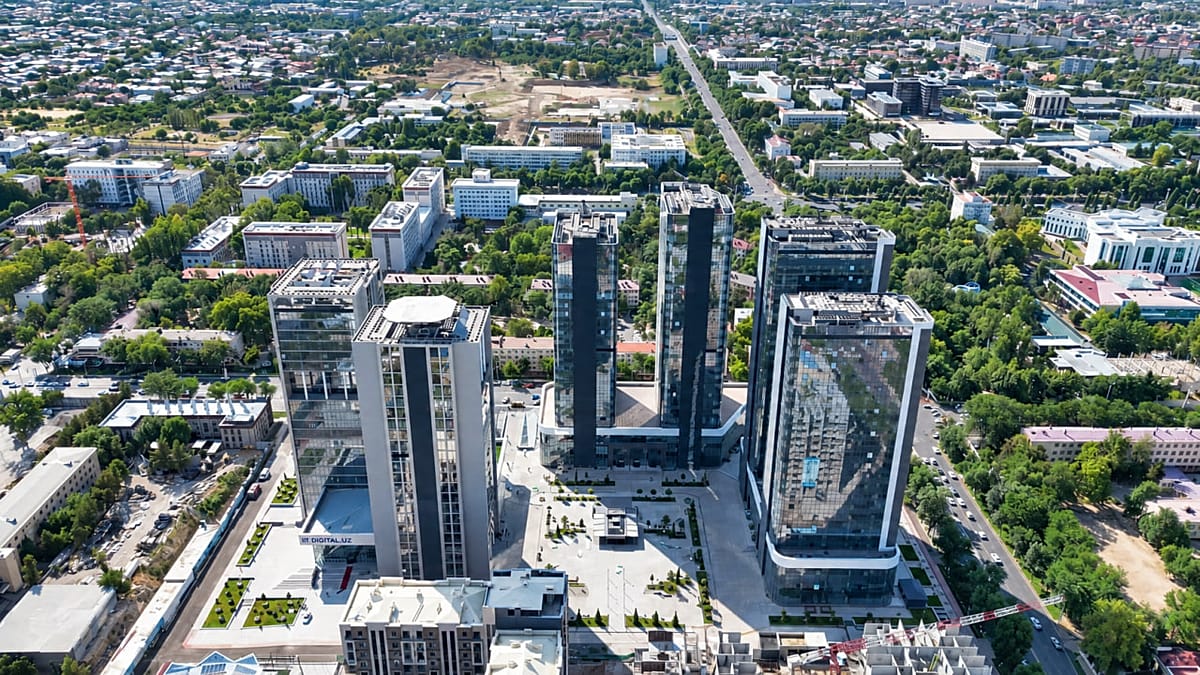
Uzbekistan is seeking to build direct links between its newly created Tashkent International Financial Centre and the City of London, establishing a special legal regime based on English common-law principles to attract foreign investment. Speaking at the inaugural Central Asia–UK Think Tank Forum in Tashkent, Javlon Vakhabov, Director of the International Institute for Central Asia, said the UK could offer its own investment expertise and English common law, and that the centre is seeking cooperation specifically with the City of London.
Bringing English law to Tashkent
The Tashkent International Financial Centre was created by presidential decree in March and will operate under a separate legal framework, applying English common-law principles to commercial activity within the centre, along with an independent international commercial court and arbitration mechanisms. This system will not replace Uzbekistan's broader civil-law framework, but companies operating through the centre will gain access to legal rules and dispute-resolution mechanisms widely used in international business. On 10 September, President Shavkat Mirziyoyev approved organisational measures to launch the centre.
In May, Uzbekistan's National Investment Fund, managed by Franklin Templeton, became the first Uzbek fund to debut on an international exchange, listing in London. Additional state-linked companies are now being prepared for potential international listings as Uzbekistan seeks to attract private capital while introducing stronger financial reporting and corporate-governance standards.
From political dialogue to private capital
In February, London hosted the first CA5+UK foreign ministers' meeting, establishing a new platform for regional cooperation. In investment discussions, participants emphasised the conditions needed to turn political interest into viable projects, including possible cooperation in critical minerals, agriculture, education, technology and artificial intelligence. Issues raised included legal certainty, protection of investors' rights, due diligence requirements, anti-money-laundering rules and sanctions compliance.
More specific examples of cooperation were also discussed, including partnerships with British universities, training for geologists and engineers, and possible cooperation on mineral processing. However, experts noted that, unlike state-controlled companies in other countries, Western private firms cannot be directly mobilised to serve political decisions, making it harder for political agreements alone to translate into actual investment.


