Germany Announces Closure of Berlin's Russian House, But Legal Hurdles Remain
Germany's government said it is terminating the lease of Berlin's Russian cultural center after blaming Moscow for a drone attack attempt at a German airport, though treaty obligations and property rights could complicate the closure.
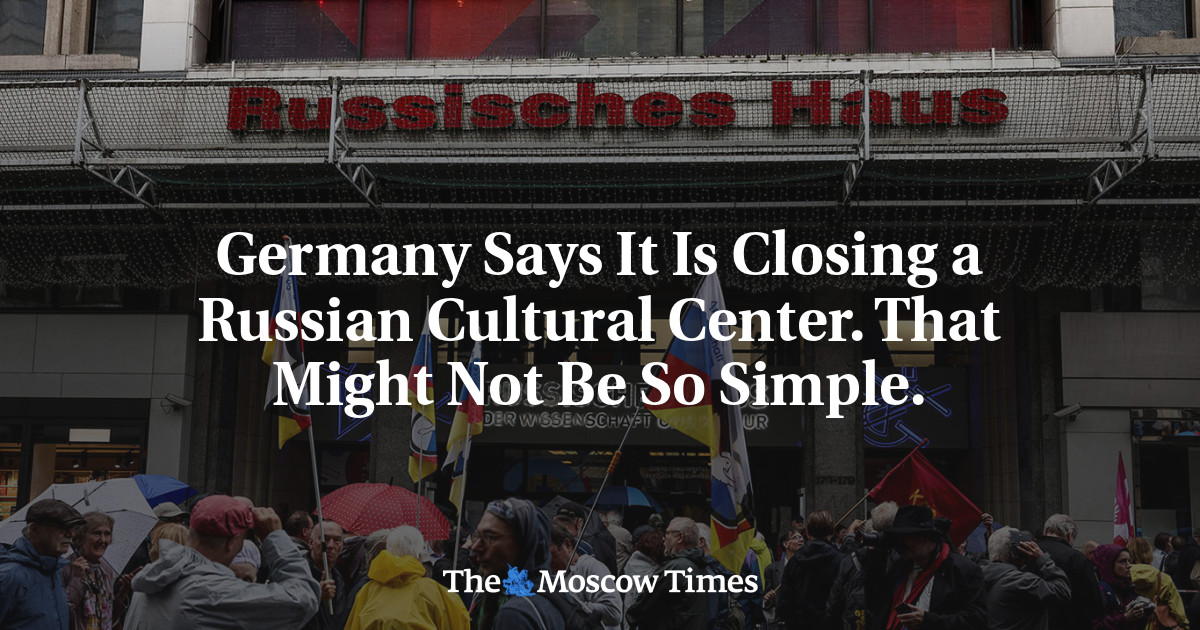
Hundreds of people gathered in Berlin on a rainy Friday evening to protest the German government's decision to terminate the lease of the Russian House, a Moscow-run cultural center. While some demonstrators demanded the decision be reversed, nearby groups included supporters of Russia's liberal opposition and roughly 100 pro-Ukraine activists who have called for the center's closure since 2022.
The protests followed Germany's announcement that it would shut the Russian House after officially blaming Moscow for an attempted drone attack at Leipzig/Halle Airport in early August. In response, Russia said it would move to close Germany's Goethe-Institut cultural centers.
What is the Russian House
The seven-story, 30,000-square-meter building in central Berlin opened in 1984 as the House of Soviet Science and Culture, later becoming the Russian House after the Soviet collapse. Organizers say it draws around 200,000 visitors annually for language courses, film screenings and cultural events. It is operated by Rossotrudnichestvo, a Russian state agency the EU sanctioned in 2022 for projecting Kremlin influence. In June 2025, a Munich court ruled the Russian House was subject to those sanctions, freezing its German bank account.
Legal obstacles
German media have noted that closing the center is not straightforward. It is governed by a 2011-2012 intergovernmental treaty that renews automatically unless canceled by Dec. 6 this year. The building itself remains Russian state property under a 2013 agreement granting Russia 99-year land use rights.
Propaganda and espionage allegations
The Russian House and its bookstore, MnogoKnig, have faced accusations of spreading war propaganda, including selling items evoking Russia's war in Ukraine. France in July accused the center of being used to cover Russian intelligence activity. A source close to the bookstore said it also sells books banned in Russia.