German organic farmer wants to use compost, but church bans it on its land
The manager of an organic farm in Mecklenburg-Western Pomerania wants to fertilise with regionally produced green-waste compost, but the church, which leases him the land, forbids it. He calls for a review of the rules on such composts.

In Mecklenburg-Western Pomerania, a federal state in northeastern Germany, Christian Ihle, who manages the organic farm "133 Hektar", cannot use regionally produced green-waste compost because the church, which leases him land, prohibits it. The farm, founded in 2019, operates in the Lassan area near the Peenestrom, opposite the island of Usedom. As a livestock-free arable farm, it relies on external inputs to build soil humus over the long term and to ensure adequate nutrient supply.
Experience with building humus
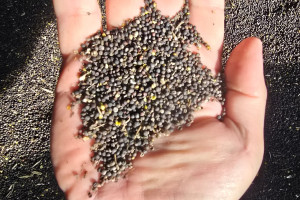
Ihle takes part in the HumusKlimaNetz, a network in which he gathers experience and shares it with other farmers. The farm has an agroforestry system with poplars and another with fruit trees, and grows frost-killed cover crops combined with spring crops such as oats, camelina and lentils.
About 6,000 poplar cuttings were planted in 2023. Today Ihle would do some things differently: instead of the 60 cm cuttings used, he recommends 90 or 170 cm ones, which cost more but establish faster. He also says one should not skimp on game protection. Two of the seven tree rows were planted in arcs along contour lines (keyline design) to slow rainwater runoff on slopes. In Ihle's view, this is more relevant for sites with steeper slopes, heavier soils and higher rainfall.
The farm relies heavily on legumes, because, as Ihle puts it, raising humus content by one percentage point requires roughly 2,500 kg of nitrogen per hectare.
Compost blocked by the landowner
Ihle would like to use green-waste compost from municipal composting plants as organic fertiliser. However, spreading municipal compost is banned on the church's leased land, probably out of concern about pollutant build-up. Storage at the field edge, unlike manure, is also only allowed under considerably stricter conditions.
The farmer notes that the compost is made from green cuttings, thermally sanitised, tested several times a year, Bioland-certified and meets all pollutant limits. He considers a legal reassessment of such composts overdue. Many organic farms without livestock face similar problems: they may use biogas digestate from conventional farms only under special conditions, and manure from other organic farms is scarce.