Solzhenitsyn Monument in Vladivostok Removed, Then Returned a Day Later
A monument to writer Alexander Solzhenitsyn was dismantled in Vladivostok, Russia, on October 20 and unexpectedly put back the next day. Historian Alexey Uvarov explains how the writer's contradictory views took shape.
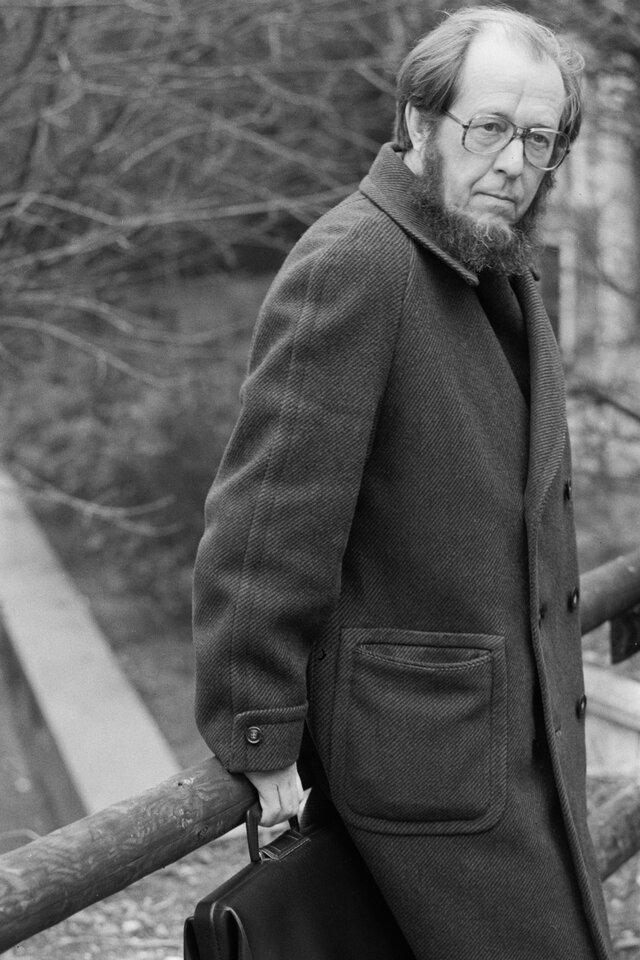
A monument to Alexander Solzhenitsyn, the writer and Nobel laureate, was dismantled on October 20 in the center of Vladivostok, a Russian city in the Far East, where it had stood since 2015. It was meant to be moved to a park commemorating victims of political repression, but the next day it was unexpectedly reinstalled. Officials said it was too large for the new site.
Vladivostok has a particular link to the story: in 1994, after 20 years in exile, Solzhenitsyn began his journey across Russia there, traveling to Moscow by train. After his return he became politically active, criticizing Mikhail Gorbachev and Boris Yeltsin while speaking favorably of Vladimir Putin. Putin, in turn, honors Solzhenitsyn's memory. At Meduza's request, historian Alexey Uvarov explains how the writer's contradictory views formed and how they foreshadowed the Russian-Ukrainian war.
From Kislovodsk to exile
Solzhenitsyn was born in Kislovodsk in 1918 and grew up in a poor family in Rostov-on-Don. In his youth he believed in communism. During World War II he served as a commander of an artillery battery and rose to captain, but began doubting Stalin's policies. He voiced this in letters to a school friend, and in February 1945 he was arrested at the front. He was sentenced to eight years in labor camps for anti-Soviet agitation.
In prison he rejected communism and returned to Christianity. After release and rehabilitation in 1957, he worked as a schoolteacher in Ryazan. In 1962 the journal Novy Mir, with Nikita Khrushchev's permission, published his novella "One Day in the Life of Ivan Denisovich," which made him famous. He received the Nobel Prize in Literature in 1970. "The Gulag Archipelago" appeared in Paris in 1973, and in 1974 he was arrested, stripped of citizenship and expelled to West Germany.
Vermont and criticism of the West
In Vermont, in the United States, he worked on the epic "The Red Wheel," supported political prisoners through a fund, and in a 1978 Harvard speech criticized Western materialism, prompting heated debate.
Return and a plan for Russia's future
Gorbachev restored his citizenship in 1990. That year, an article with a print run of nearly 27 million copies called on Russia to abandon imperial ambitions and not use force against republics seeking independence. At the same time, Solzhenitsyn advocated keeping a union of Russia, Ukraine, Belarus and Kazakhstan and redrawing some republics' borders, considering parts of their territory historically Russian. The proposals on Ukraine's and Kazakhstan's borders drew sharp criticism. The USSR collapsed the next year, and on May 27, 1994, the writer returned to Russia.

