New monkey species with orange lips discovered 'hiding' in DRC forest
A monkey with striking orange-pink lips has been confirmed as a new species in the Democratic Republic of Congo, marking only the fifth African monkey species discovered in 75 years.
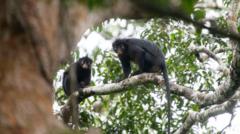
New species found in Lomami National Park
Scientists have confirmed that a black-furred monkey with distinctive pinkish-orange lips and a black face living in the forests of the Democratic Republic of Congo is a new species. The primate was spotted and photographed high in the canopy of dense tropical forests in Lomami National Park, in the central-east of the country.
Conservationists first reported the unusual animal in 2008, but only captured a single blurry photograph. After another sighting ten years later, an international team set out to find and study the monkey, revealing it was a previously unknown species. This is only the fifth African monkey species discovered in the last 75 years.
Junior Amboko, a PhD student at Florida Atlantic University, led the search involving audio recordings, photography, and genetic analysis. The findings were published in the journal PLoS One.
Known locally as Likweli
Although new to science, some local people already knew of the monkey and call it “Likweli.” Amboko said the monkeys are shy and hide high in trees. The team interviewed people in 52 villages near the animals' habitat, but only residents of eight villages had ever seen them.
The research team from DRC, the US, and Germany gave the animal the Latin name Colobus congoensis, recognizing the country's natural diversity. It belongs to the colobus group, which lack thumbs. Prof. Kate Detwiler from Florida Atlantic University explained that these herbivores feed on leaves and seeds, playing a crucial role in forest regeneration.
Distinctive appearance and call
The bright facial markings may serve as visual signals to other animals, possibly for mating or identification. The monkeys also have a distinctive roaring call. “You often hear them, but don't see them,” Amboko said.
Researchers believe the animals are rare and restricted to a forest area with suitable food and habitat. They are hunted for meat, so scientists hope that official protection can now be granted following the classification as a distinct species. The team plans further surveys to estimate population size and study behavior.