Australia urged to legalise plug-in solar panels following UK's lead
An advocacy group says Australian households could save up to $370 a year if plug-in solar panels were legalised, as they now are in the UK. The devices are currently sold in Australia but cannot legally be connected to power outlets.
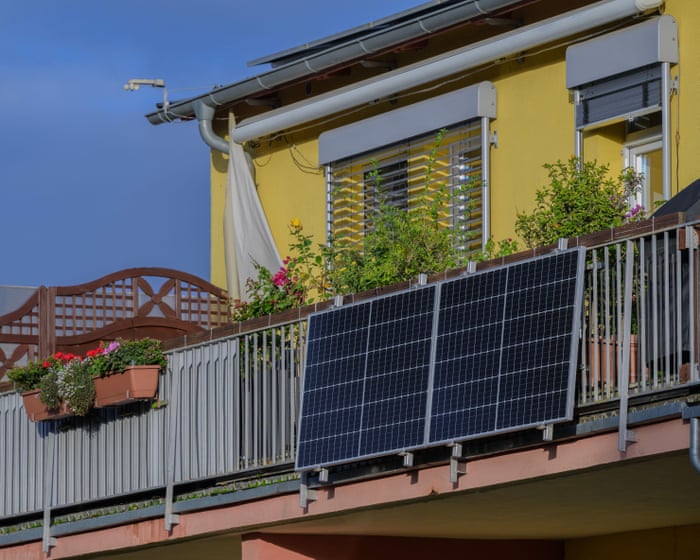
An Australian advocacy group is calling on governments to legalise plug-in solar panels — small, standalone solar units that can be attached to a balcony or placed in a backyard and connected directly to a power socket to offset household appliance use.
Researchers estimate that residents of capital cities could save between $226 and $372 a year using such a system. While these devices are already sold in Australia, plugging them into the electricity network is not currently permitted.
Heidi Lee Douglas, chief executive of Solar Citizens, said more than a third of Australians who rent or live in apartments are missing out on savings that homeowners with solar already enjoy. The campaign follows this week's legalisation of plug-in solar in the United Kingdom, where units went on sale from Thursday. Douglas said more than three million Australians are being left behind because regulations have not kept pace with the technology, pointing to Germany, Spain and New Zealand as other countries where such systems are already permitted.
Solar and battery engineer Glen Morris, of the Smart Energy Lab, said an 800-watt system can generate enough power to run a fridge, television and other appliances during daylight hours. He said a roughly $1,000 kit pays for itself within three years and continues to operate for two decades, making it, for many renters, the only form of solar ownership available — one they can take with them when they move.
According to research by Energy Consumers Australia, only about 11% of renters have solar installed, compared with 44% of homeowners, with a similar gap between apartment dwellers and those in houses. The research attributed the disparity partly to a "split incentive" problem, where landlords bear the upfront installation costs while tenants capture most of the benefit, and to structural barriers apartment residents face due to rules governing common property.
Separately, the research recorded a record quarterly investment in large-scale solar, with 1.8 gigawatts reaching final investment decision — the strongest figure since tracking began. The regulator's acting chair, Carl Binning, said the pace of the energy transition is accelerating, noting that more than 500,000 applications have been received under the government's home battery subsidy program.