After eight years, BepiColombo sheds propulsion module on final approach to Mercury
The joint European-Japanese BepiColombo mission successfully jettisoned its propulsion module this week, clearing a key step before entering orbit around Mercury in November. Early telemetry shows the maneuver worked as planned, with solar panels now generating power for the first time.
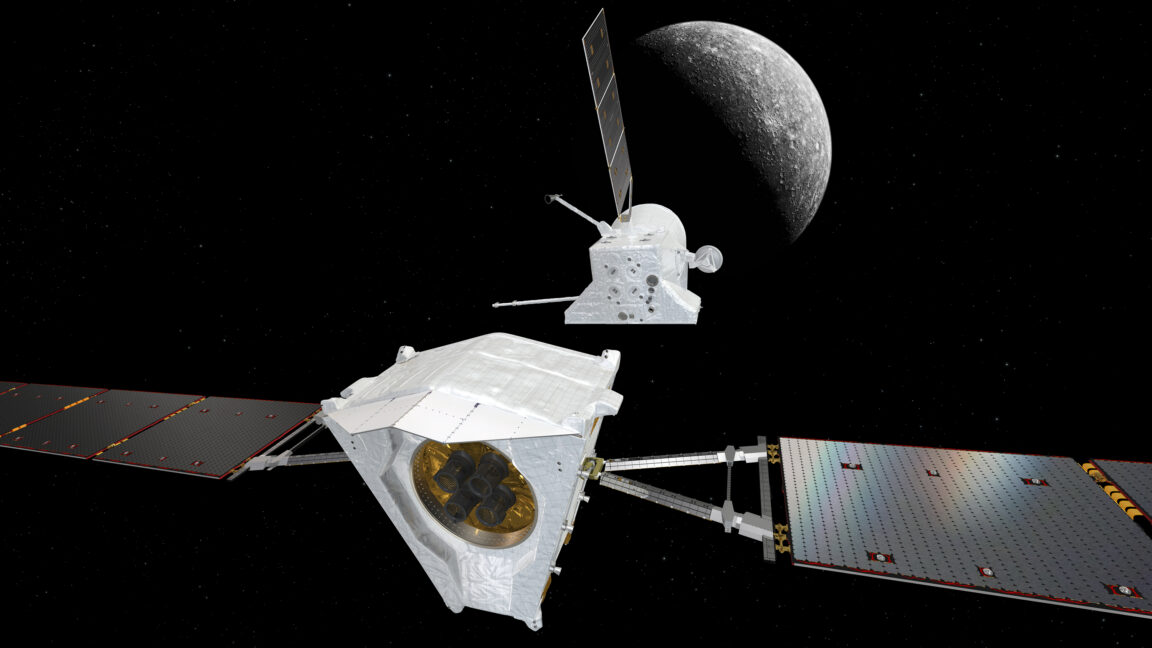
The European Space Agency's BepiColombo mission, developed with contributions from Japan and the United States, has reached a major milestone in its eight-year journey to Mercury. The nearly $2 billion mission has spent years spiraling toward the Sun since its 2018 launch, relying on ion thrusters and nine planetary flybys of Earth, Venus, and Mercury to build up the speed needed to be captured into orbit around the innermost planet.
On Thursday, the spacecraft separated from its Mercury Transfer Module, the section that supplied power and propulsion throughout the cruise phase. With that job complete, the module had to be discarded before BepiColombo can enter orbit in November. The mission is actually a stack of three spacecraft: the transfer module and the European-built Mercury Planetary Orbiter, plus Japan's Mercury Magnetospheric Orbiter, nicknamed Mio. Following Thursday's separation, the two orbiters continue traveling together and will part ways in December, shortly after arriving in their initial orbit around Mercury.
A risky maneuver close to the Sun
The separation took place about 63 million kilometers from the Sun — less than half of Earth's distance — in an environment of extreme heat and radiation. An ESA official compared the difficulty of the operation to launching an entirely new spacecraft, citing considerable risk. After separation, the remaining spacecraft had to take over power generation, propulsion, and pointing on its own.
Early signs indicate the operation went smoothly. Telemetry showed the Mercury Planetary Orbiter's solar arrays, which had not faced the Sun during the cruise, are now generating power and recharging batteries that had been drained during the separation. Freeing the spacecraft from the transfer module will also allow several instruments and its best cameras, previously blocked by the module, to be used for the first time.
The journey hasn't been without setbacks — a partial loss of power in the ion thrusters in 2024 forced engineers to extend the cruise by a year. BepiColombo has now traveled more than 10 billion kilometers since leaving Earth and is on track to enter orbit around Mercury on November 21. Routine science observations are expected to begin next April. By placing two spacecraft in orbit simultaneously, the mission aims to shed light on Mercury's origins and how solar wind has shaped the planet over time.
/nginx/o/2026/09/03/17895100t1h0ff3.png)