David Hockney: A Winking Celebration of Queer Life Through Art
David Hockney's works, from 'A Bigger Splash' to intimate domestic scenes, have become symbols of queer identity, emphasizing beauty and intimacy without explicit imagery.
Six decades after David Hockney painted 'A Bigger Splash', reproductions of the work have become a visual motif in gay households. Hockney, an openly gay artist, depicted same-sex desire long before partial decriminalization in England and Wales in 1967.
Unlike artists such as Robert Mapplethorpe or Keith Haring, Hockney did not use highly sexualized or activist imagery. Instead, he reshaped ideas of beauty, intimacy, and desire. In 1961, while a student at the Royal College of Art, he created 'We Two Boys Together Clinging', one of the earliest expressions of queer identity in British art. The title, from a Walt Whitman poem, was obscure enough to avoid censorship.
His 1962 work 'Cleaning Teeth, Early Evening (10pm) W11' shows two figures brushing their teeth, with toothpaste tubes positioned suggestively. This winking approach left little to the imagination for those 'in the know' while maintaining innocence for the masses.
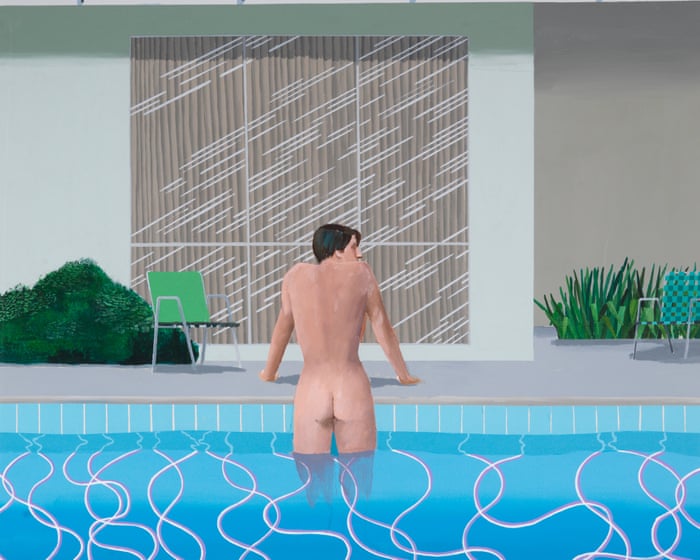
After moving to Los Angeles in 1964, Hockney found greater freedom to live openly as a gay man. His paintings portrayed California as a fantasy land of swimming pools and palm trees. 'Peter Getting Out of Nick’s Pool' (1967) shows a nude young man, with his bare buttocks as the focal point—highly controversial at the time. 'California' (1965) depicts two men nude on lilos, and 'Portrait of an Artist (Pool With Two Figures)' shows a clothed man watching a swimmer.
Hockney's revolutionary contribution was not just male nudity and desire, but scenes of domesticity: men swimming, showering, and brushing teeth together. This challenged the notion that same-sex desire was solely about physical acts, presenting it as beautiful and tender.
His work merged queer identity with fine and decorative arts. Influenced by fashion designer Ossie Clark, Hockney reimagined pool surfaces as patterned textiles, proving that 'decorative' was not a dirty word. He achieved gay visibility in establishment spaces, threatening to cancel a 1988 Tate exhibition in protest of Section 28.
Hockney's legacy lies in a hard-to-describe aesthetic that feels 'a bit gay'—whether in portraits of his pet dachshunds or bright Yorkshire landscapes. He continually reinvented himself through collage, video, printmaking, public art, and iPad drawings. Hockney not only saw the beauty in gay life but shared it with the world.


