Europe still holds strategic leverage over China in several technologies
Despite China's push for technological self-reliance, the European Union remains a key partner in semiconductors, aerospace, pharmaceuticals, automotive chips, and robotics, though experts doubt Europe can use this dependence as a bargaining chip due to China's rare earth monopoly.
According to an analysis by Euronews, China's dependence on the European Union in strategic technologies, while declining, remains significant. China's 15th Five-Year Plan prioritizes technological independence by 2030, but in several sectors, European companies still supply essential products.
Semiconductors Dutch company ASML holds a near-monopoly on extreme ultraviolet (EUV) lithography machines, critical for advanced chip manufacturing. Although the US and the Netherlands have restricted sales of this technology to China, Beijing can still buy less advanced deep ultraviolet (DUV) machines, where ASML controls almost 90% of the market. Experts say China is racing to catch up and aims to produce its own chips without ASML machines by 2028, but remains dependent for learning. Maintenance and repair of installed equipment also account for a significant share of European supplier revenues.
Aerospace China's Comac C919 narrow-body airliner relies heavily on European suppliers: France's Safran (engine), Germany's Liebherr Aerospace (cabin pressure system), and Italy's Avio Aero (engine casing). Without these companies, China would not have a civil aviation program, experts say. A quiet certification battle is underway, with China seeking approval from the European Union Aviation Safety Agency (EASA) for the C919 to operate in Europe. Beijing has responded by slowing certification of new Airbus aircraft in China, where Airbus holds a 55% market share.
Pharmaceuticals and biotechnology Europe leads in pharmaceutical patents: in 2024, companies in Italy, Germany, and France had double the number of patents granted compared to China. Vaccine market leaders Merck, Sanofi, and GSK accounted for 51% of global market share in 2024. However, China's R&D investment grew 16.2% annually from 2020 to 2024, twice the pace of Europe. In joint ventures, technology transfer almost always benefits China, experts note.
Automotive chips Chinese automakers BYD and Chery depend on chips from European companies such as Infineon, NXP, and STMicroelectronics. China's domestic demand for EVs creates an import substitution challenge. Meanwhile, the EU relies on China for packaging, assembly, and testing, as shown by last year's dispute over Nexperia.
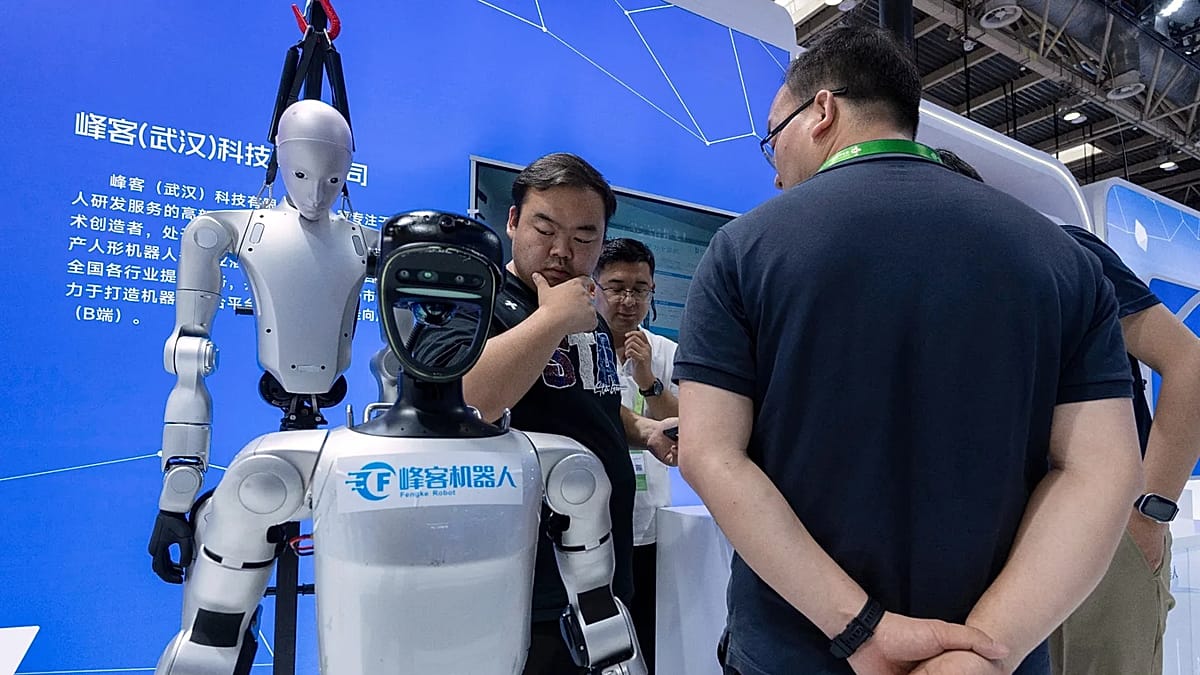
Robotics and quantum computing Chinese humanoid robots contain key components from European firms like Sweden's Ewellix and Germany's Rexroth. In quantum computing, China wishes to collaborate with Europe, but EU member states are divided: France, the Netherlands, and Germany impose strict export controls, while Spain and Italy have active projects with Chinese companies. Without a unified approach, China could circumvent restrictions.